AI voice interviews are the technology changing how recruiters evaluate candidates faster than anything else. You have 15 candidates to interview for a sales executive role. By phone, that takes three days: coordinating schedules, calling, getting voicemail, rescheduling, conducting the interview, writing down responses, repeat. With AI-powered automated interviews, all 15 are interviewed within 24 hours — each one on their own time, without you picking up the phone once.
We're not talking about chatbots that send questions via text. We're talking about real voice interviews, where an AI with a natural-sounding voice asks the candidate questions, listens to their answers, adapts the conversation flow, and generates a report with scores, strengths, and a hiring recommendation. All while you're working on something else.
A study from the University of Chicago and Erasmus University covering over 70,000 applications found that 78% of candidates prefer being interviewed by AI when given the option. Not because it's trendy — because it's more convenient and less anxiety-inducing.
In this guide, I'll explain exactly what AI voice interviews are, how they work under the hood, why voice outperforms text, and what you can expect as a recruiter when you implement them.
Contents
- What an AI voice interview is (and what it isn't)
- How an AI voice interview works step by step
- Why voice over text: what written responses don't reveal
- What types of AI interviews exist
- The real problem it solves: the math behind recruiting
- What the research says: data from 70,000+ applications
- AI interviews in LATAM: the window that's still open
- 5 mistakes recruiters make when implementing AI interviews
- Frequently asked questions about AI voice interviews
What an AI voice interview is (and what it isn't)
An AI voice interview is a real conversation between a candidate and an artificial intelligence that speaks, listens, and responds with a natural-sounding voice. It's not a form with a microphone. It's not a chatbot that transcribes. It's a conversational interview where the AI asks questions, processes answers in real time, and adapts follow-up questions based on what the candidate said.
The candidate receives a link. They click it, connect from their phone or computer, and the interview begins. No installation required. No account creation. No scheduling with anyone. They can do it at 10 AM or 11 PM — the AI is available 24/7.
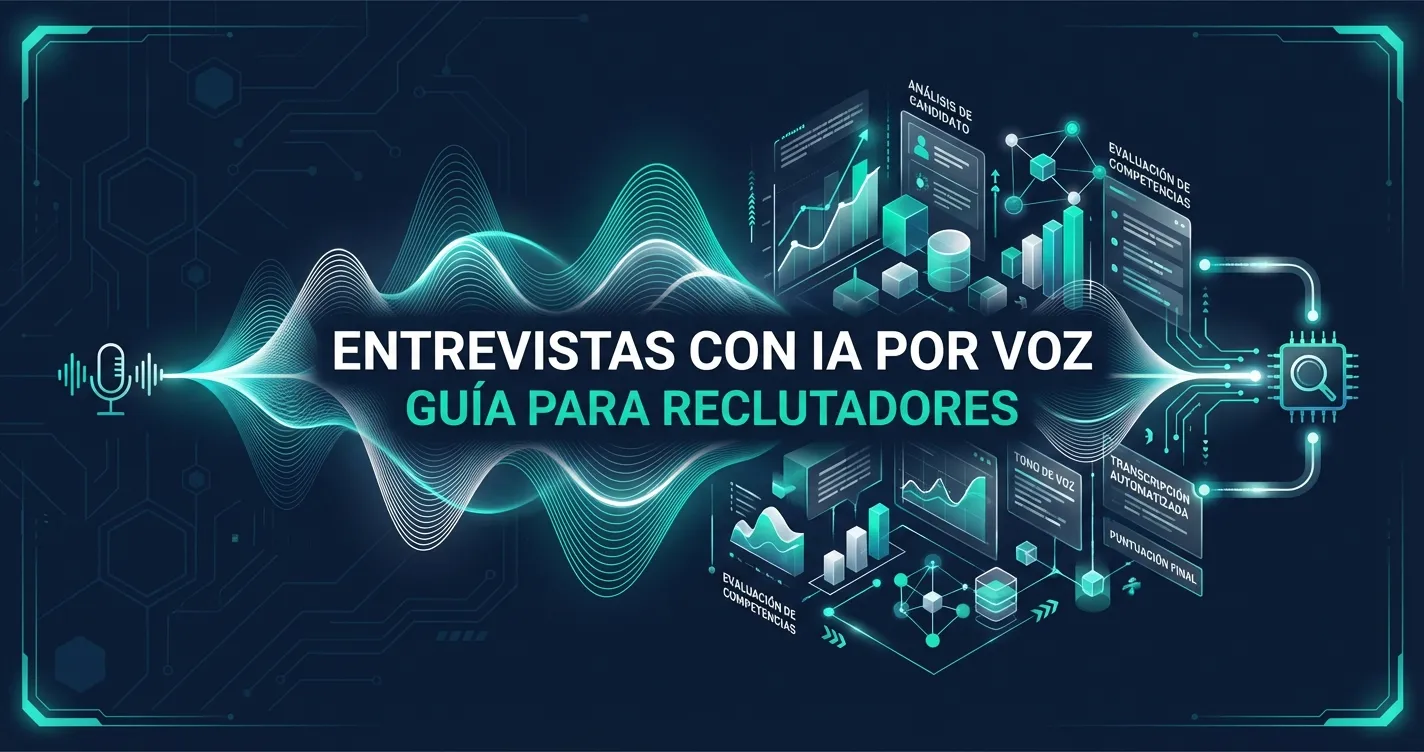
On the recruiter's side, what you get is a complete report: a numerical score for each competency evaluated, a transcription of the responses, an analysis of strengths and areas for improvement, and a substantiated hiring recommendation. All without being present during the interview.
What it's NOT: It's not a pre-recorded video where the candidate answers a screen with zero interaction. Those are asynchronous video interviews — the candidate talks alone, with no feedback, no follow-up questions. AI voice interviews are interactive: the AI listens, processes, and responds. If the candidate gives an interesting answer, the AI digs deeper. If the answer is vague, the AI asks a follow-up.
It's also not a replacement for the final interview with the hiring manager. It's the intelligent screening layer that lets you reach that final interview with candidates who've already been evaluated in depth — not candidates who just "looked good on paper."
How an AI voice interview works step by step
The process has four stages. Each one solves a specific problem in traditional recruiting.
Stage 1: Setup (5 minutes)
You choose the type of interview you need. Is it an initial screening to filter 50 candidates? A technical assessment for programming? A language interview to verify English proficiency? A soft skills evaluation covering communication and teamwork?
There are over 80 types of AI interviews organized into categories: technical, language, soft skills, role-specific, general screening, situational, psychological, cognitive, cultural fit, software skills, and certifications. If you want to explore all the options, the AI interview catalog shows each category with examples.
You set the duration (10, 15, 20 minutes), the depth level, and the evaluation criteria. The platform generates a unique link for that interview.
Stage 2: The candidate interviews
You send the link to the candidate via email, WhatsApp, or whatever channel you use. The candidate clicks it whenever they want — it doesn't depend on your schedule. The AI introduces itself, explains how the interview works, and begins.
The conversation uses natural voice, not robotic speech. The AI uses Google Gemini technology to speak with human-like intonation, natural pauses, and contextual understanding. If the candidate says "I worked at a fintech doing corporate client onboarding," the AI doesn't ask "what is onboarding?" — it understands the context and goes deeper: "How many corporate clients were you handling per month, and what was your main challenge?"
The key point: the interview is adaptive. It's not a fixed list of questions read in order. The AI adjusts the flow based on responses. If it detects an interesting area, it explores it. If it detects an evasive answer, it follows up. This is what sets it apart from a form with voice input. If you want to see exactly what the candidate experiences, the Candidate Interview Experience tutorial walks you through it step by step.
Stage 3: Analysis and scoring
As soon as the interview ends, the AI generates the report. It doesn't take hours — it's available within minutes. The report includes:
Score per competency. Not a generic "pass/fail" number. It's a breakdown for each competency evaluated. If you assessed communication, problem-solving, and technical knowledge, you get a specific score for each.
Strengths analysis. What the candidate demonstrated well, with concrete examples from their responses.
Areas for improvement. Where they were weaker, with context on which question revealed it.
Recommendation. A substantiated assessment of whether the candidate should advance to the next stage. You can see a real report example in the Interview Reports and Results tutorial.
Stage 4: Informed decision
With the report in hand, you know exactly who you want to interview personally. It's not a leap of faith based on the CV — it's an informed decision based on how the candidate expressed themselves, reasoned, and responded under pressure.
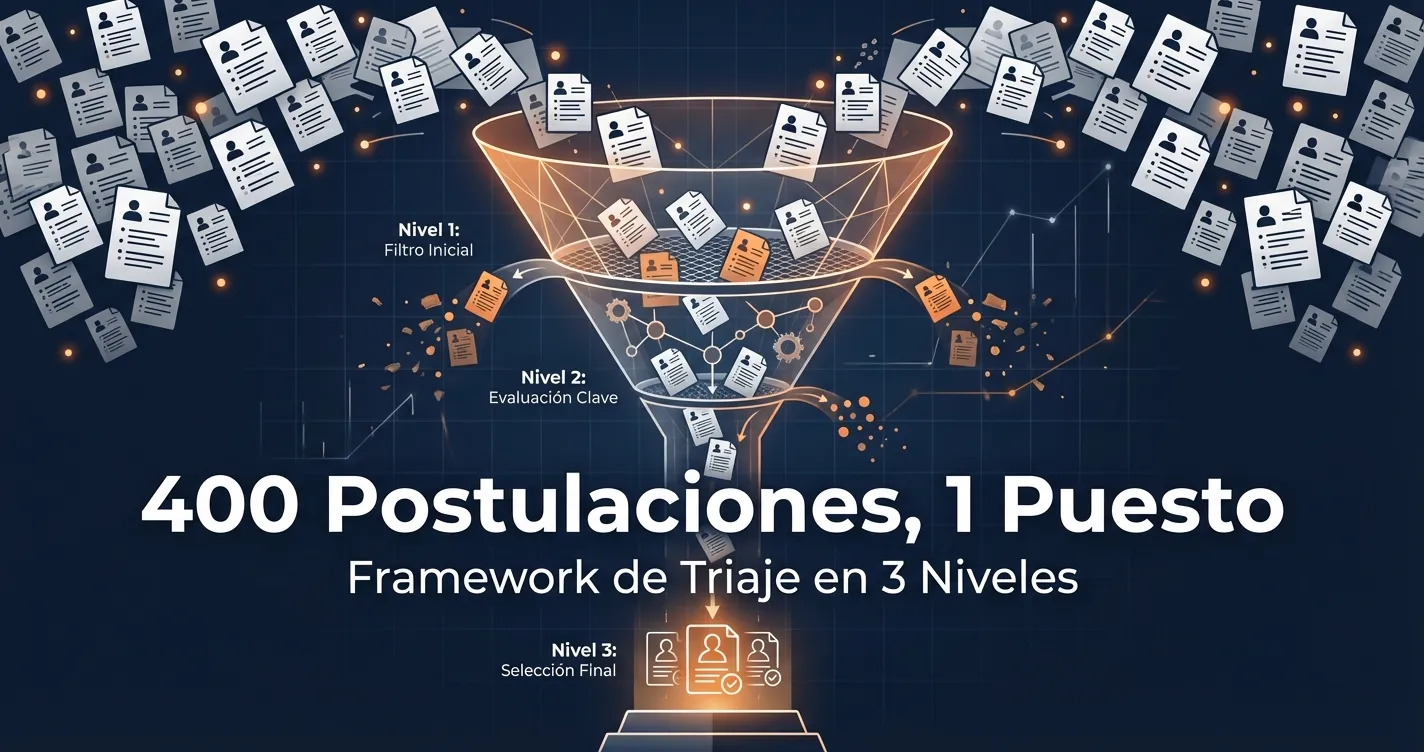
If you had 50 candidates, instead of interviewing 15 by phone to find 3 good ones, the AI interviewed all 50 and you review the reports of the top 10. Three days down to two hours.
Why voice over text: what written responses don't reveal
If AI can interview via text (chatbots, written forms), why does voice matter? It matters a lot. And the difference isn't cosmetic.
Voice reveals soft skills that text hides. When a candidate writes, they have time to edit, rewrite, Google the answer, and craft the perfect response. When they speak, they don't. Voice captures how they think in real time: the clarity of their reasoning, their ability to improvise, how they structure ideas on the fly.
Voice verifies language skills for real. If you're evaluating English proficiency, a text chatbot won't cut it. The candidate can use a translator, copy phrases, or get help. In a voice interview conducted in English, their real level is exposed within the first 30 seconds. Pronunciation, fluency, listening comprehension, ability to respond without preparation.
Voice detects real communication ability. Some candidates write impeccable emails but can't explain an idea in a meeting. And vice versa — people who write poorly but communicate with striking clarity when they speak. If the role involves interaction with clients, teams, or stakeholders, you need to know how they talk, not how they write.
Voice eliminates copy-paste. Written responses in text-based interviews have a growing problem: candidates generate them with ChatGPT. They copy the question, paste it into the chat, polish the answer, and submit. In a real-time voice interview, that's not possible. What you hear is what the candidate knows, thinks, and can articulate.
Voice is more natural for the candidate. 78% of candidates prefer AI voice interviews because it feels like a conversation, not a written exam. Less anxiety, more naturalness, better responses. Everyone wins.
What types of AI interviews exist
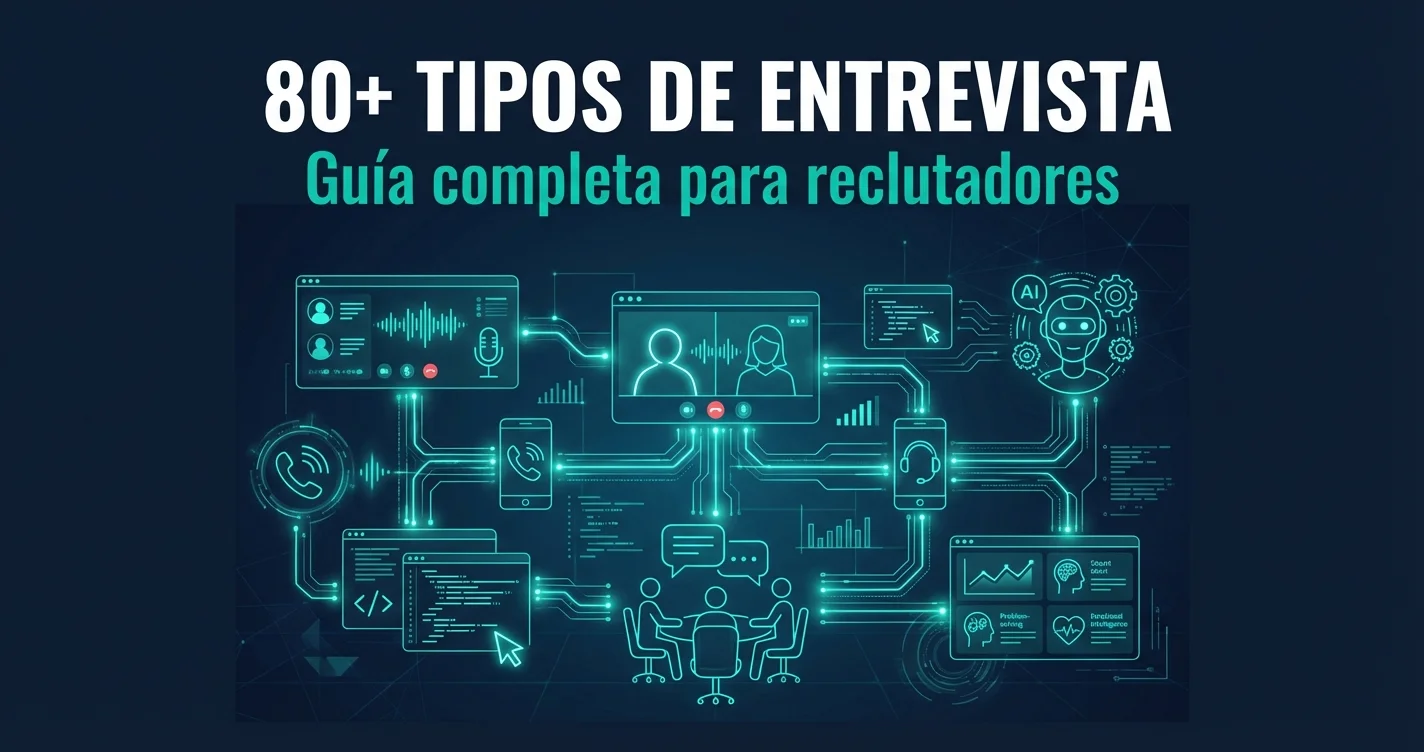
AI voice interviews aren't a one-size-fits-all format. There are over 80 types, organized into 11 categories. Each one evaluates something different and is used at a different stage of the hiring process.
Screening interviews. The most widely used. They filter candidates at the first stage by evaluating basic requirements, motivation, and general fit. They're short (10–15 minutes) and process high volume. Ideal when you have 100+ candidates and need a quick first cut.
Technical interviews. Assess role-specific knowledge: programming, finance, marketing, sales, etc. The AI asks technical questions and evaluates depth of knowledge, not just whether they know the right answer.
Language interviews. Verify real proficiency in English, Portuguese, or other languages. The interview is conducted entirely in the target language. They measure comprehension, fluency, vocabulary, and ability to express ideas in professional contexts.
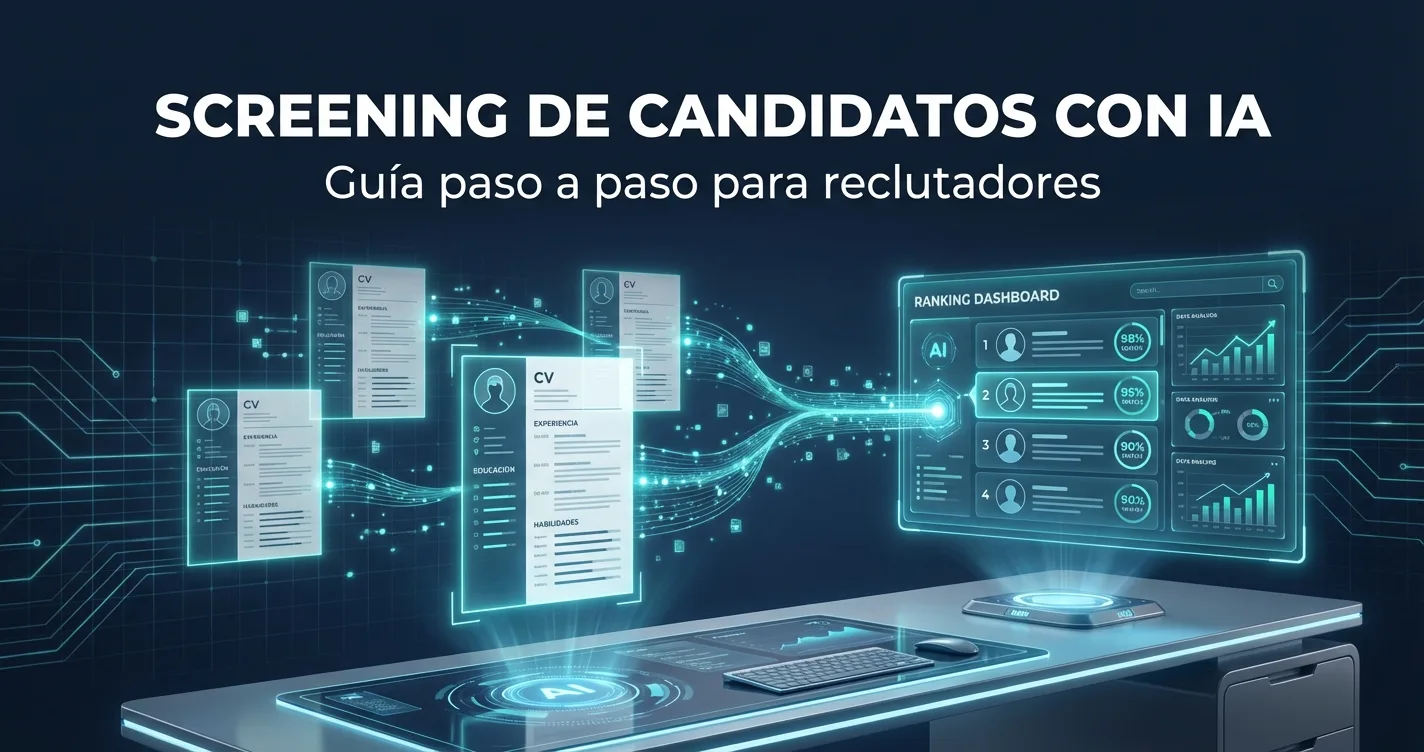
Soft skills interviews. Evaluate communication, leadership, teamwork, problem-solving, and critical thinking. They use adaptive behavioral and situational questions. If you're already using AI-powered CV screening to filter candidates, these interviews are the perfect complement to evaluate what the resume doesn't show. For a deeper analysis of which soft skills AI can measure, check out the guide on evaluating soft skills with AI.
Role-specific interviews. Designed for specific positions: sales executive, developer, data analyst, customer service, team lead. The questions are calibrated for what matters in that particular role.
Situational interviews. Present hypothetical job scenarios and evaluate how the candidate would respond. "You have an angry client who wants to cancel their contract — what do you do?" The AI evaluates the approach, not whether there's a "correct" answer.
Psychological and cognitive interviews. Assess thought patterns, analytical capacity, logical reasoning, and decision-making styles. These are the most specialized and are used for leadership positions or roles requiring strategic thinking.
Cultural fit interviews. Evaluate alignment between the candidate and the organization's values and work style. They don't look for everyone to think the same — they assess compatibility with the work environment.
Certification and software interviews. Verify specific knowledge in tools (Salesforce, SAP, advanced Excel) or professional certifications.
The real problem it solves: the math behind recruiting
Professional recruiters don't need anyone to tell them they're busy. They live it. But putting numbers to the problem helps illustrate what AI voice interviews actually solve.
Without AI: the daily reality.
The average recruiter spends 42% of their time just coordinating interviews. Not conducting them — coordinating schedules. That's 16–17 hours per week sending emails like "does Thursday at 3 PM work?", getting back "no, Friday is better," proposing another option, waiting for confirmation.
Each screening phone call takes 15 to 30 minutes. With 15 candidates per search, that's 4 to 8 hours of screening interviews alone — for a single position. If you're managing 5 active searches, multiply by five.
And then you have to note what each candidate said, compare responses across candidates, and decide who advances. All manual, all relying on your memory and your notes.
With AI voice: the same task, different timeline.
Zero hours of coordination. The candidate receives a link and interviews when they want. All 15 candidates interview in parallel — they can literally all do it at the same time, at 3 AM if they want. The AI doesn't have a calendar.
Zero hours of in-person screening. The AI conducts all 15 interviews. You review 15 reports, which takes 30 to 45 minutes. You identify the top 3–5 and interview them personally for the final decision.
The concrete numbers. If a recruiter handles 1,000 candidates per month:
- Without AI: 300 hours reading CVs + 100 hours of screening interviews + coordination = nearly 3 full-time people just for the first stage
- With AI: minutes of CV processing + automated interviews + 20 hours reviewing reports = 380+ hours saved per month
That's not marginal efficiency. It's the difference between needing a team of 5 recruiters or getting the same work done with 2.
The average time-to-hire in 2025 is 68.5 days — nearly double what it was in 2023 at 36–44 days. AI voice interviews directly attack the stages that consume the most time: screening and initial evaluation.
What the research says: data from 70,000+ applications
AI voice interviews aren't just a technology pitch. There's solid research backing them up.
The largest study to date is "Voice AI in Firms: A Natural Field Experiment on Automated Job Interviews," published in 2025 by Brian Jabarian (University of Chicago Booth) and Luca Henkel (Erasmus University Rotterdam). They analyzed over 70,000 applications in a real field experiment — not in a lab.
The results:
78% of candidates choose AI when given the option. Not out of curiosity — out of convenience. Control over when to take the interview, less social pressure, and less anxiety than facing a human interviewer.
12% higher likelihood of receiving a job offer. Candidates interviewed by AI had better offer conversion rates, stronger indicators of actually starting the job, and higher retention. With no drop in productivity among those hired.
50% less perceived discrimination. Candidates interviewed by AI reported half the sense of gender discrimination compared to human interviews. AI has no affinity bias, doesn't judge by appearance, and applies the same criteria to everyone.
Superior predictive quality. Structured interviews — which is exactly what AI delivers — predict job performance 2x better than unstructured interviews (correlation coefficient of 0.43 vs. 0.24). And they reduce evaluation bias by up to 85%.
Why does AI achieve this? Because it combines the best of both worlds. It applies structure (same base questions, same criteria, objective scoring) with conversational naturalness (human-like voice, adaptive responses, contextual follow-ups). It's a structured interview with the experience of a natural conversation.
An important nuance: for senior roles, McKinsey's research (2024) found that unstructured interviews reveal 38% more insights about strategic thinking. AI handles this with adaptive branching — questions that branch based on the candidate's seniority, allowing more room for deep exploration when the role requires it.
AI interviews in LATAM: the window that's still open
The global AI interview market grew from $1.7 billion in 2025 to $2.22 billion in 2026, with a projection of $6.4 billion by 2030. Adoption is accelerating: 80% of companies will use AI in some part of their hiring process by 2026.
But in Latin America, the picture is different. And that's an opportunity, not a disadvantage.
Formal adoption is low. Less than 1% of job postings in LATAM mention AI tools as a requirement. Only 37% of professionals in Mexico use AI tools daily. Most HR consultancies and staffing agencies in the region still do manual screening and phone interviews one by one.
The demand for efficiency is surging. The talent acquisition technology market in LATAM is projected to grow from $15.2 billion in 2024 to $30 billion by 2033. Demand for tech talent in the region grew 36% year-over-year. And nearshoring is accelerating everything: 72% of US companies plan to expand hiring in LATAM in 2025–2026, seeking talent in AI, cloud, and cybersecurity — precisely the areas with the greatest scarcity.
The gap is the opportunity. Recruiters and consultancies that adopt AI voice interviews now are entering while the field is wide open. In the US and Europe, there's already saturation of tools and fierce competition. In LATAM, the recruiter who offers AI interviews today differentiates immediately from the competition.
And there's a cultural factor: voice interviews work especially well in the region because verbal communication is central to Latin American professional culture. We're not replacing conversation — we're supercharging it.
5 mistakes recruiters make when implementing AI interviews
The technology works. The mistakes are in the implementation.
Mistake 1: Using it to replace all human interaction
The AI interview is a powerful screening tool, not a replacement for your final interview. The candidate needs to meet the team, understand the culture, and feel that it's a decision made by people, not machines. Use AI to filter and evaluate; use your time for the candidates who truly matter.
Mistake 2: Not telling the candidate what to expect
"You'll receive a link for a voice interview with artificial intelligence" — that's the bare minimum you need to communicate. If the candidate doesn't know what to expect, the experience generates pushback. When they know, 78% prefer it. The difference is prior communication. If you want to see the full flow from the candidate's perspective, check out the How to Create an AI Interview tutorial, which includes how to share the link.
Mistake 3: Evaluating everything with the same type of interview
Don't use a screening interview for a senior position. Don't use a technical interview when you need to evaluate soft skills. Each interview type is designed for a specific purpose. Choosing the wrong one gives you irrelevant data.
Mistake 4: Ignoring the report and trusting your gut
If the AI gives you a report showing candidate A scored 85/100 on communication and candidate B scored 62, but you "liked" candidate B better because of their CV, you're paying for a tool you're not using. Reports are data — don't ignore them.
Mistake 5: Not iterating on evaluation criteria
The first interview you set up won't be perfect. After the first 10–15 candidates, review the reports: do the scores correlate with your subsequent evaluation? Are the questions capturing what you need? Adjust the criteria. The AI learns from the structure you give it.
Frequently asked questions about AI voice interviews
Do candidates reject AI interviews?
Less than you'd think. The study of 70,000+ applications showed that 78% choose AI when they can. The key is communicating clearly what they'll experience. Younger candidates (Gen Z, Millennials) have even higher adoption rates.
How long does an AI voice interview last?
It depends on the type. A quick screening can be 10 minutes. A full technical or soft skills evaluation, 15–20 minutes. You define the duration when setting it up.
Does it work for senior roles or only for high-volume positions?
It works for both, but with different interview types. For high-volume positions (operators, salespeople, customer service) the quick high-volume screening is ideal. For senior roles, deeper interviews with adaptive branching that explores strategic thinking and leadership are used.
Can the AI interview in multiple languages?
Yes. Language interviews are conducted entirely in the target language — English, Portuguese, or others. You can also run the screening interview in Spanish and add a separate language evaluation.
How much does it cost to implement AI interviews?
Platforms work with credit-based or monthly subscription models. A plan for small consultancies starts at $199/month and includes enough credits to process hundreds of candidates. Compared to the cost of recruiter-hours saved, the ROI is positive from the first month. You can see the details on the pricing page.
Keep reading
- AI candidate screening: a step-by-step guide — How to automate CV reading and the first filter before the interview.
- How to evaluate soft skills with artificial intelligence — What the CV doesn't say: communication, leadership, and critical thinking measured by AI.