AI candidate screening is the most efficient way to process high volumes of CVs today without losing valuable candidates. Professional recruiters spend between 20 and 28 hours per week reading CVs — eighteen minutes on average per resume. Open it, read it, mentally cross-reference the experience against job requirements, decide pass or fail, jot down a note somewhere, repeat. If you're managing 50 active searches with 200 candidates each, the math is simple: there aren't enough hours in the day.
And the most frustrating part isn't the wasted time. It's knowing that among those hundreds of CVs there are perfect candidates you'll never find because they get buried in the avalanche.
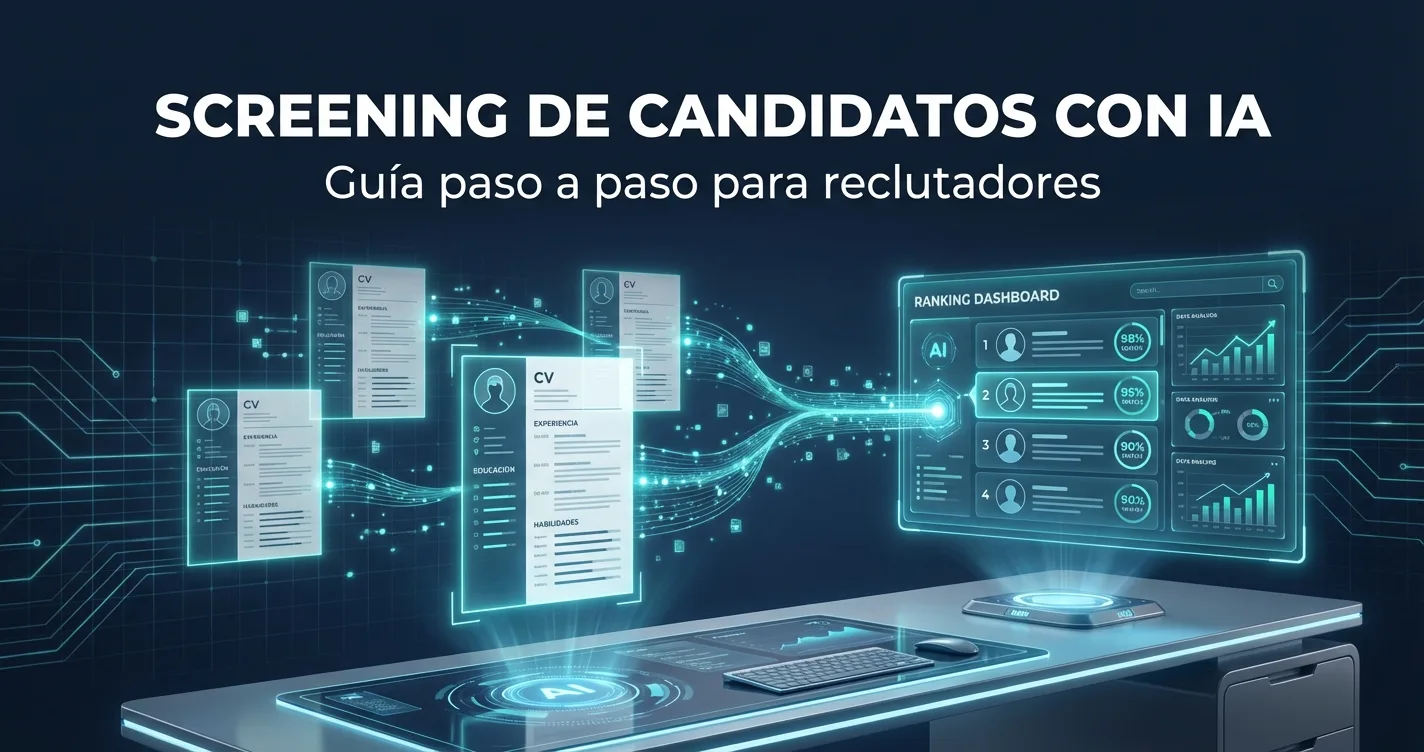
AI recruitment software solves exactly this. It doesn't replace your judgment — it amplifies it. It analyzes each CV in seconds, cross-references it against job requirements, generates a score, and presents a ranking. You still decide who moves forward. But instead of spending 18 minutes per CV, you spend less than one.
In this guide, I'll walk you through how it works, what the AI actually evaluates, how to implement it step by step, and what mistakes to avoid.
Contents
- What is AI candidate screening (and what it's not)
- Why manual screening no longer works
- How AI screening works: the step-by-step process
- The next level: screening + AI interviews
- 5 common mistakes when implementing AI screening
- How much time does automated CV screening save
- How to choose an AI recruitment software
- FAQ about AI candidate screening
What is AI candidate screening (and what it's not)
AI screening is the process of using artificial intelligence to automatically analyze, evaluate, and rank candidates against the requirements of a specific role.
But let's clarify something important: AI doesn't make hiring decisions. It doesn't say "hire this one" or "reject that one." What it does is process information that would take a human hours, identify patterns a human might miss, and present results so you can make better decisions faster.
In practice, an AI screening system does three things:
First, it extracts data from the CV — names, work experience, education, technical and soft skills, languages, certifications. It doesn't matter if the CV is a clean PDF or a blurry image: the AI reads it just the same. If you want to understand this process in depth, check out the guide on how to analyze CVs with artificial intelligence.
Second, it evaluates against requirements — it cross-references what it extracted from the CV against what you need for the role. If you require 3 years of B2B sales experience and the candidate has 5 years in retail sales, the AI doesn't just see "sales" — it understands the context is different and scores accordingly.
Third, it generates a ranking — it orders candidates from highest to lowest fit with the role. It shows you the best matches first, with a numerical score and the reasons behind that score.
What it's NOT: it's not a binary keyword filter. The old systems in traditional ATS platforms searched for exact words — if the CV didn't say "Python" but said "backend development," it was discarded. Modern AI understands synonyms, context, and semantic relationships. That's a fundamental difference.
Why manual screening no longer works
Manual screening had its moment. When a recruiter managed 5 searches with 20 candidates each, reading CVs one by one was feasible. That scenario no longer exists.
HR consulting firms handle dozens of simultaneous searches. Staffing agencies receive hundreds of applications per day. BPOs need to fill positions in hours, not weeks. Volume changed, but the method didn't.
The problem isn't just time. It's the consequences of manual screening at scale:
Inconsistency. When the same recruiter reads CV #1 at 9 AM fresh with their coffee and CV #150 at 6 PM exhausted, they don't evaluate the same way. And if it's two different recruiters, the inconsistency multiplies.
Unconscious bias. Studies from the University of Chicago demonstrated that candidates with "whiter-sounding" names receive 50% more callbacks with the same CV. It's not malice — it's the human brain running on autopilot when tired. AI doesn't have that problem.
Lost candidates. When you're under time pressure, your brain looks for shortcuts. You go straight to the most recent experience, the job title, the university. If the best candidate has an unconventional CV format or their relevant experience is in their second job, you skip right over them.
Bottleneck for growth. If your screening capacity depends on man-hours, your business has a ceiling. To process more candidates, you need more recruiters. More recruiters mean higher fixed costs. The equation doesn't work.
How AI screening works: the step-by-step process
Beyond the specific technology, the workflow for automating CV screening follows a common logic. Here it is in 5 steps.
Step 1: Define the job requirements
Everything starts with what you need. AI isn't magic — it's only as good as the criteria you give it. Before uploading a single CV, you need to be clear about what you're looking for:
Minimum required experience (years and type), essential vs. desirable technical skills, academic background (if truly relevant for the role), languages and required proficiency level, critical soft skills for the role, and any specific requirements like certifications or availability.
The more specific your criteria, the better the screening will be. "I need someone in marketing" is vague. "I need someone with 3+ years in B2B digital marketing, experience in lead generation, and proficiency in HubSpot or similar" gives the AI something concrete to evaluate against. To see how this works in practice, the Skillan Academy tutorial How to create a new job search walks you through it step by step.
Step 2: Upload the CVs
Modern systems accept bulk uploads. You can upload 50, 100, or 200 CVs at once — PDF, Word, image, or even scanned documents. Some allow direct import from job boards or email forwarding.
The point is there's no practical limit to how many CVs you can process simultaneously. If you receive 300 applications for a sales position, all 300 go into the analysis. You don't hand-pick which ones are worth reading. You can see how uploading works in the Skillan Academy tutorial Upload Candidate CVs.
Step 3: AI processes and extracts CV data
This is where the magic happens. The AI reads each CV and extracts structured data: contact information, work experience (company, role, duration, responsibilities), education, technical and soft skills, languages, certifications.
Modern platforms use natural language processing (NLP) to understand context, not just words. If a CV says "I led a team of 12 people during the SAP migration," the AI understands there's leadership experience, team management, project management, and SAP — even though none of those words appear literally. You can read more about this process in the guide on analyzing CVs with AI.
Step 4: Evaluation against requirements and scoring
With the extracted data, the AI compares each candidate against the requirements you defined. It generates a numerical score (for example, 0 to 100) that reflects the degree of fit with the role.
But the valuable part isn't just the number. It's the breakdown: why one candidate scored 87 and another 62. You want to see which requirements they meet, which they don't, where they're strong, and where they have gaps. A good screening system gives you that transparently. The Academy tutorial AI Screening System shows exactly what this comparison matrix looks like.
Step 5: Review the ranking and make decisions
The AI presents candidates ordered by score. Best fits at the top, least fitting at the bottom. Your job now is to review the top 10-20 (instead of the original 300), validate that the analysis makes sense, and decide who moves to the next step.
This is key: the final decision is always yours. The AI did the heavy lifting of filtering, but professional judgment — reading between the lines, considering cultural fit, evaluating career trajectory — remains human.
The next level: screening + AI interviews
CV screening solves the first half of the problem: finding candidates worth interviewing. But the other half — conducting the initial interview — still consumes time.
A phone screening interview lasts between 15 and 30 minutes. If you have 20 candidates who passed the CV screening, that's 5 to 10 hours of calls for just one search. Multiply by the number of searches you're handling simultaneously.
The most advanced platforms combine CV screening with AI-conducted interviews. The flow is: AI analyzes the CV, generates a ranking, sends an interview link to the candidate, the AI interviews them by voice in real time, and generates a report with scoring, strengths, areas for improvement, and a recommendation.
The candidate interviews when it's convenient for them (day, night, weekend — the AI is available 24/7), doesn't need to download anything or create an account, and the experience is a natural conversation, not a form.
For the recruiter, the result is a report that says: this candidate scored 85/100 on the CV screening and 78/100 on the AI interview. Their strengths are X, their areas for improvement are Y, and our recommendation is to advance to the next stage. With that, your decision is much more informed than with a CV alone.
AI interviews also allow you to evaluate soft skills like communication, leadership, and critical thinking — competencies that a CV cannot measure.
5 common mistakes when implementing AI screening
Mistake 1: Vague criteria
If you ask the AI for "someone good at sales," you'll get mediocre results. Be specific with requirements. The clearer they are, the better the algorithm performs.
Mistake 2: Blindly trusting the score
The score is a guide, not a verdict. A candidate with a score of 75 who has particular experience you know from the market may be better than one with 90 who comes from an irrelevant context. Use the ranking to prioritize, not to automatically discard.
Mistake 3: Not reviewing results the first few times
When you start with a new platform, dedicate time to comparing what the AI says with your own judgment. This helps you calibrate criteria and trust (or adjust) the system.
Mistake 4: Uploading low-quality CVs
If your CVs are blurry screenshots or corrupted files, the AI will have trouble extracting data. Bulk upload is great, but make sure files are readable.
Mistake 5: Not combining with interviews
CV screening tells you what the candidate did. The interview tells you how they think, how they express themselves, and how they react. Using screening alone without interviews is like hiring with half the information.
How much time does automated CV screening save
Let's do the math with a real example. A mid-sized consulting firm managing 10 active searches with 100 candidates each:
Without AI: 1,000 CVs x 18 minutes = 300 hours of reading per month. That's nearly 2 full-time recruiters doing nothing but reading CVs.
With AI: 1,000 CVs processed in minutes. The recruiter reviews the top 10 of each search (100 profiles) spending 5 minutes on each = 8.3 hours. Savings: over 290 hours per month.
That's not a marketing number — it's basic math. And we're not even counting the savings on screening interviews if you also use AI interviews.
How to choose an AI recruitment software
If you're evaluating tools, these are the questions that matter:
Does it do real screening or just keyword matching? Many ATS platforms claim to have "AI" but only do keyword matching. Ask whether it uses natural language processing and semantic evaluation.
Can I see why a candidate got a specific score? Transparency is essential. If the AI gives you a number without explanation, you can't validate or adjust.
Does it accept bulk CV uploads? If you have to upload one at a time, it doesn't scale.
Does it integrate with AI interviews? The real productivity leap is screening + interviews on a single platform.
Is pricing transparent? If you have to request a quote to find out how much it costs, you probably won't like the answer.
Was it trained with CVs from your market? An AI trained with US resumes won't understand job titles, universities, or career paths from Latin America.
FAQ about AI candidate screening
Does AI screening replace the recruiter?
No. It replaces the mechanical part of the work — reading, comparing, and filtering CVs. Professional judgment, cultural evaluation, and the final decision remain human. AI is a tool that makes you more productive, not a replacement.
Can AI read CVs in Spanish?
It depends on the platform. Global tools are trained primarily with English-language CVs. Platforms focused on Latin America — like Skillan — are trained with over 100,000 real CVs in Spanish, which improves accuracy for regional job titles, universities, and career paths.
How much does it cost to implement AI screening?
Platforms range from $15/month (basic parsing) to $800+/month (full screening with AI interviews and dashboards). For consulting firms and agencies, the ROI is immediate: if you save a recruiter 20 hours per week, the tool pays for itself in the first month. Check Skillan plans and pricing for a concrete reference.
How accurate is AI screening?
Modern platforms achieve over 90% accuracy in CV extraction and evaluation. It's more consistent than a human reading 200 CVs in a row, where fatigue progressively reduces accuracy. The best systems show you the score breakdown so you can validate each evaluation.
Can I combine CV screening with soft skills evaluation?
Yes. The most complete platforms first analyze the CV (technical fit) and then conduct an AI interview to evaluate soft skills like communication, problem-solving, and critical thinking. The result is a comprehensive candidate evaluation.
Conclusion
AI candidate screening isn't the future — it's the present. Recruiters who still read every CV manually are competing against firms that process 10 times more candidates in the same number of hours.
The transition isn't complicated. You don't need to be technical, you don't need to change your entire process. You simply replace the most tedious part (reading and comparing CVs one by one) with a tool that does it in seconds and with greater consistency.
Your professional judgment remains irreplaceable. AI just frees you to use it where it really matters: on decisions, not on reading.
Want to see how it works in practice? Skillan analyzes CVs and conducts AI voice interviews. Try it free — no credit card required.
Keep reading
- How to analyze CVs with artificial intelligence — The technical process behind CV extraction, evaluation, and ranking.
- How to evaluate soft skills with AI — What the CV doesn't tell you: communication, leadership, and critical thinking measured with AI.