Soft skills evaluation with AI is one of the most powerful — and most underutilized — tools in modern recruiting. A candidate has the perfect CV. Ten years of experience, the certifications you asked for, a track record at well-known companies. You hire them. Three months later you discover they can't work in a team, can't handle pressure, and communicate so poorly that the rest of the team prefers to solve things without involving them.
This happens all the time. And it happens because the CV measures experience and technical knowledge, but doesn't measure how a person thinks, how they communicate, how they react when things go wrong, or how they collaborate with others. If you're already using AI CV screening to filter candidates, evaluating soft skills is the logical next step.
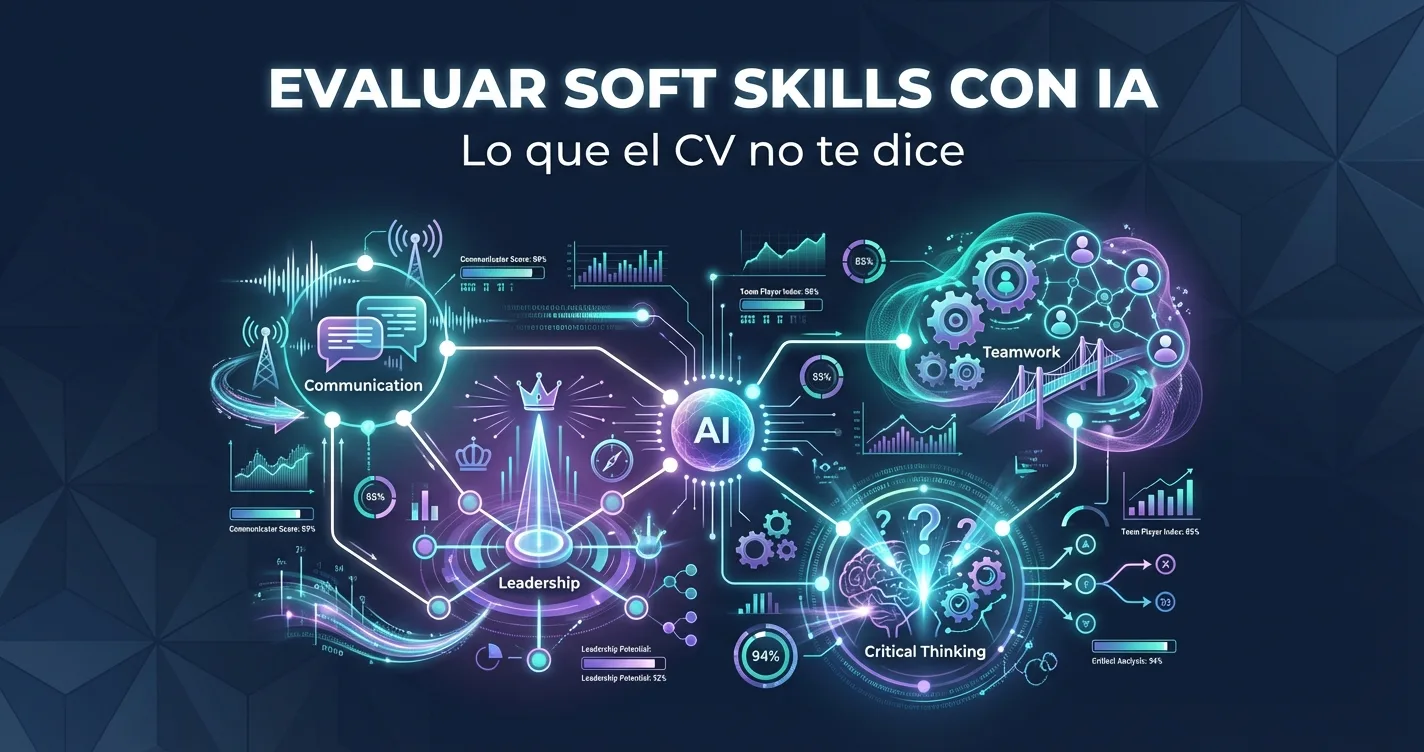
Soft skills — communication, leadership, adaptability, problem-solving, critical thinking, teamwork — are what determine whether someone actually works out in a role. And they're exactly the ones that are hardest to evaluate in a traditional hiring process.
Artificial intelligence is changing that. It doesn't replace human judgment about who "fits" culturally, but it can consistently and objectively measure soft competencies that previously depended entirely on the interviewer's intuition.
In this guide, I'll explain which soft skills AI can evaluate, how it does it, what its limits are, and how to implement it in your process.
Contents
- Why soft skills are so hard to evaluate
- Which soft skills AI can evaluate (and which it can't)
- How AI soft skills evaluation works
- AI interviews vs. psychometric tests for measuring soft skills
- How to implement AI soft skills evaluation in your process
- Common mistakes in soft skills assessment
- The ROI of evaluating soft skills correctly
- FAQ about AI soft skills evaluation
Why soft skills are so hard to evaluate
Evaluating soft skills has always been recruitment's weak spot. And it's not due to a lack of importance — everyone knows they matter. It's the very nature of what you're trying to measure.
They're subjective by definition. What one interviewer considers "good communication," another sees as "talks too much." What one interprets as "leadership," another views as "authoritarianism." Without standardized criteria, each evaluator measures something different.
They depend on context. A candidate can be an excellent communicator in a face-to-face interview and terrible over email. They can lead a technical team well but fail leading a sales team. The soft skill isn't absolute — it depends on where and how it's applied.
They're easily faked. Any candidate with interview experience knows what to say when you ask "tell me about a time you had to lead a team through a difficult situation." Rehearsed answers sound convincing but don't predict real behavior.
Interviewer bias is enormous. Studies show that interviewers decide whether they like a candidate within the first 7 minutes and spend the rest of the interview seeking confirmation. Affinity bias — preferring people similar to yourself — distorts the entire soft skills evaluation.
There's no clear metric. You can measure whether someone knows Excel by having them solve an exercise. How do you measure critical thinking? How do you put a number on empathy? The lack of metrics makes evaluations inconsistent across candidates and across processes.
Which soft skills AI can evaluate (and which it can't)
Not all soft skills lend themselves to AI evaluation. Some do, quite well. Others, not yet.
What AI evaluates well
Verbal communication. In an AI voice interview, the system analyzes clarity of expression, discourse structure, coherence between ideas, vocabulary, and ability to synthesize. It doesn't evaluate whether the voice is "pleasant" — it evaluates whether the message is transmitted effectively.
Problem-solving. Through situational questions ("what would you do if...?") or practical cases, the AI evaluates how the candidate structures their thinking, whether they identify the key variables of the problem, whether they propose viable solutions, and whether they consider consequences.
Critical thinking. The AI can present scenarios with contradictory or incomplete information and evaluate whether the candidate identifies inconsistencies, asks the right questions, and reaches reasoned conclusions instead of impulsive answers.
Adaptability. Through questions that change direction or unexpected scenarios during the interview, the AI measures how the candidate reacts to the unforeseen. Do they become unsettled? Do they pivot naturally? Do they ask for clarification?
Ability to synthesize. When the AI asks "explain a complex topic to me in 2 minutes," it's measuring the ability to prioritize information, eliminate the non-essential, and communicate what matters. It's a critical competency in any professional role.
Results orientation. In responses to behavioral questions (situation-action-result), the AI evaluates whether the candidate speaks in terms of concrete results or stays in vague descriptions of activities.
What AI still doesn't evaluate well
Genuine empathy. AI can detect if someone uses empathic language ("I understand your point," "I put myself in your shoes"), but it can't measure whether they truly feel empathy or just perform it. That still requires human interaction.
Interpersonal chemistry. The "fit" with a team or a manager is something perceived in direct interaction. AI can't predict whether two people will work well together.
Deep emotional intelligence. AI can measure components of emotional intelligence (verbal self-awareness, response regulation), but EI is a complex construct that manifests in sustained real interactions, not in a 20-minute interview.
Inspirational leadership. AI can evaluate whether someone has leadership experience and articulates a vision well, but the ability to inspire others is something seen in practice, not in a conversation.
How AI soft skills evaluation works
The process has three layers that work together.
Layer 1: Interview design
The evaluation starts before the candidate says a word. The system selects specific questions for the soft skills you want to measure.
For communication, it might use: "Explain what your current job involves as if I knew nothing about the field." For problem-solving: "Your team has a deadline in 48 hours and the person who knew the most about the project just resigned. What do you do?" For critical thinking: "Your boss asks you to implement a strategy you believe will fail. How do you handle it?"
The questions are designed to be open-ended — there's no correct answer. What matters is how the candidate structures their response, not what they answer. You can explore all available types in the AI Interview Catalog at Skillan Academy.
Layer 2: Real-time analysis
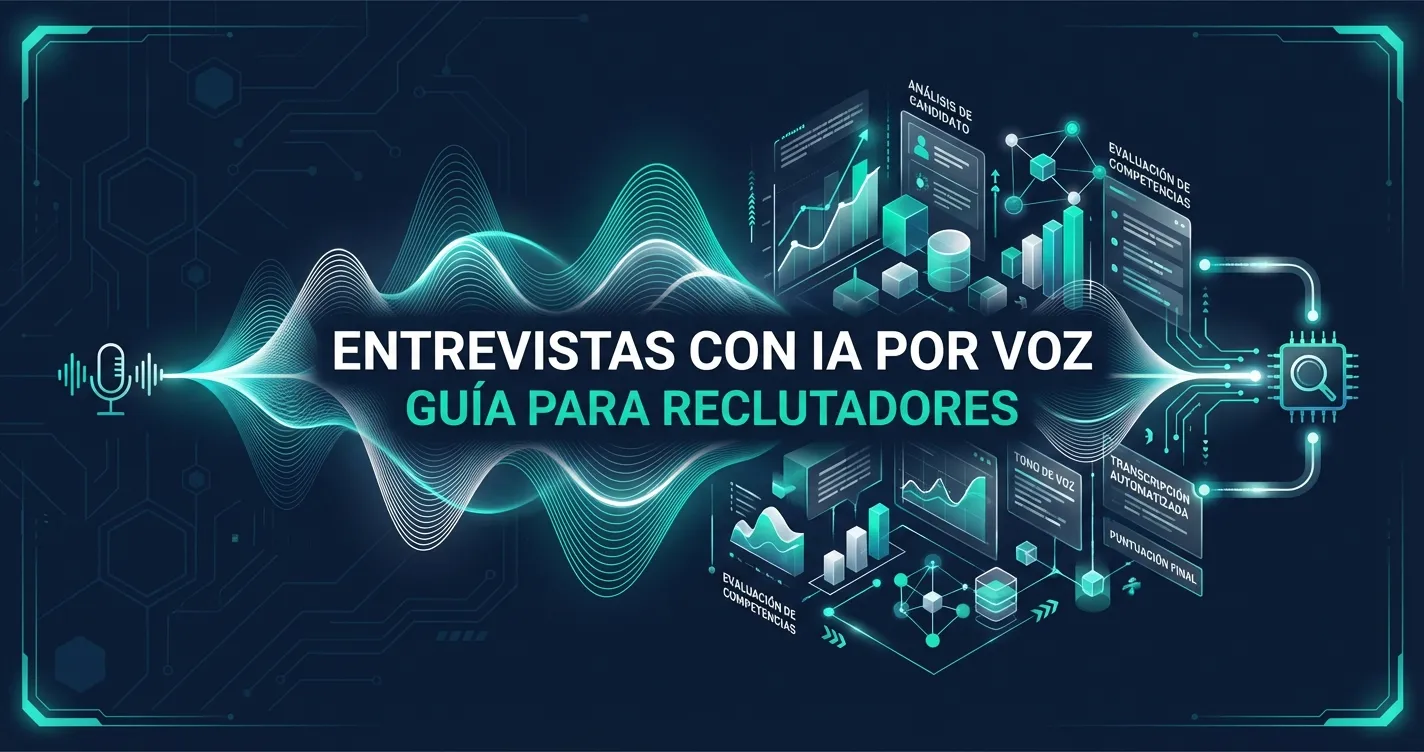
During the voice interview, the AI analyzes multiple dimensions simultaneously:
Content: What they say. Is the response relevant? Do they address the full question or veer off? Do they use concrete examples or generalizations?
Structure: How they say it. Do they organize ideas logically? Is there an introduction, development, and conclusion? Or do they jump between topics without a common thread?
Depth: How far they go. Do they stay on the surface ("it was difficult but we solved it") or get into detail ("I identified that the root problem was X, proposed Y as a solution, and the result was Z")?
Consistency: Are responses coherent with each other? If they say they value teamwork but all their examples are individual achievements, there's a discrepancy the AI detects.
Adaptive follow-up questions: If the response is vague, the AI probes deeper. "You mentioned you led the project. Can you give me a concrete example of a difficult decision you made?" This prevents candidates from getting away with generic answers.
Layer 3: Scoring and reporting
At the end of the interview, the AI generates a report with scores for each soft skill evaluated. But the value isn't just in the number — it's in the evidence.
The report says: "Communication: 82/100. The candidate structures ideas clearly, uses concrete examples, and adapts language to context. Area for improvement: tends to dwell on details and loses focus on the conclusion."
That's infinitely more useful than an interviewer saying "I thought they communicate well." The tutorial Interpreting reports and results shows you exactly how to read these reports.
AI interviews vs. psychometric tests for measuring soft skills
They're complementary, not competitors. But there are important differences.
Psychometric tests (DISC, MBTI, Big Five) measure personality traits through multiple-choice questionnaires. They're standardized, quick, and easy to administer. The problem: they measure what the candidate says about themselves, not what they do. A candidate can respond strategically to present the profile they think you're looking for.
AI voice interviews measure behavior in real time. The candidate can't Google the answer or pick the option that sounds best. They have to think, articulate, and respond on the spot. It's closer to a real work situation.
The ideal combination: psychometric test for a baseline of personality traits + AI interview to see how those traits manifest in practice. The test tells you the candidate has a high "attention to detail" profile. The interview shows you whether they actually give detailed and structured responses or just self-identify that way.
How to implement AI soft skills evaluation in your process
Step 1: Choose which soft skills matter for the role
Not all positions require the same soft skills. A senior developer needs critical thinking and technical communication. A sales leader needs persuasion and objection handling. A project manager needs organization and assertive communication.
Define 3-5 critical soft skills per role. More than that dilutes the evaluation.
Step 2: Place the evaluation at the right moment in the process
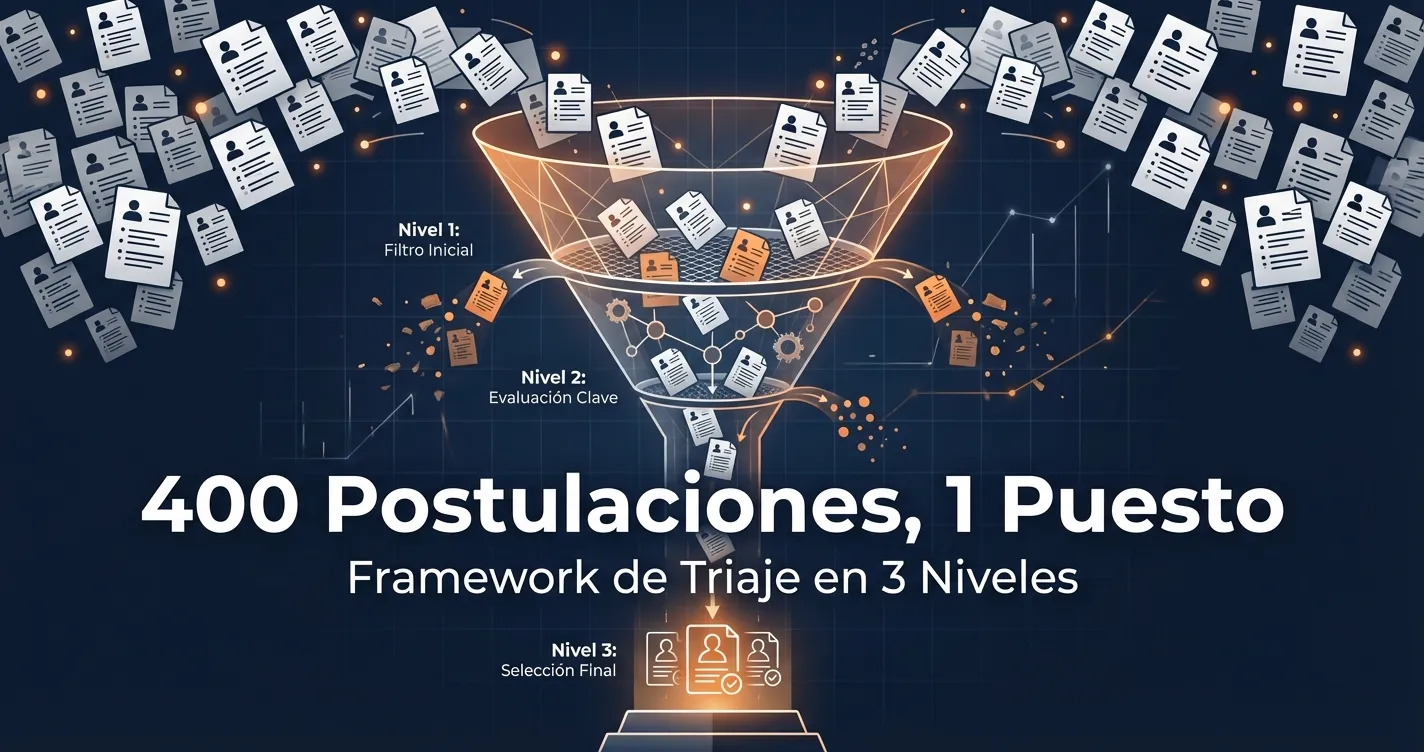
AI soft skills evaluation works best after AI CV screening and before the human interview. The ideal flow is:
- AI CV analysis — candidate ranking by technical fit
- AI interview — soft skills evaluation of top candidates
- Human interview — final validation, cultural fit, negotiation
This way, when you sit down to interview, you already have concrete data on the candidate's soft skills. You don't start from zero.
Step 3: Use reports as input, not as a verdict
The AI report says: "This candidate has a high score in problem-solving but low in communication." Your job is to contextualize: does the role require constant communication, or is it a more independent position? A low communication score may be irrelevant for a data analyst but critical for an account manager.
Step 4: Compare candidates with data, not memory
When you have 10 candidates interviewed by AI, you can compare soft skills scores side by side. Instead of vaguely remembering that "the third one seemed more communicative than the fifth," you have data: Candidate 3 scored 85 in communication, Candidate 5 scored 72. And you can see why — the evidence is in the report.
Common mistakes in soft skills assessment
Evaluating everything for everyone
Not all positions need the same soft skills at the same intensity. Evaluating "leadership" for a junior who'll be an individual contributor is noise. Focus on what truly matters for the role.
Discarding candidates for a low score in one soft skill
A candidate may have a low score in "verbal communication" but excellent in everything else. If the role is mostly written or technical, that low score may be completely irrelevant. Look at the whole picture, not an isolated number.
Not calibrating expectations by level
Soft skills manifest differently based on experience. A junior with good problem-solving will give simpler answers than a senior — and that's fine. Make sure evaluation criteria are adjusted to the position's experience level.
Comparing soft skills across different roles
The "communication" score for a sales position isn't comparable with one for an engineering position. The questions are different, the contexts are different, the expectations are different. Always compare within the same process.
The ROI of evaluating soft skills correctly
The cost of a bad hire is estimated between 30% and 200% of the position's annual salary. And most bad hires don't fail due to lack of technical knowledge — they fail because of soft skills issues.
The employee who doesn't communicate well creates friction in the team. The one who can't handle pressure collapses at the first tight deadline. The one without critical thinking escalates every problem without trying to solve it. These issues are expensive, slow to identify, and difficult to resolve once the person is already on board.
Evaluating soft skills with AI before hiring doesn't eliminate all risks, but it significantly reduces the probability that a technically qualified candidate turns out to be an operational disaster. And it does so consistently — without depending on whether the interviewer had a good day or whether the candidate is skilled at rehearsing answers.
FAQ about AI soft skills evaluation
Can AI evaluate leadership?
Partially. AI can measure how a candidate articulates their leadership experience, whether they speak in terms of team results (not just individual ones), and whether they demonstrate strategic thinking. What it can't measure is the ability to inspire others day-to-day — that's only visible in practice.
Do AI interviews replace psychometric tests?
They don't replace them — they complement them. Tests measure stable personality traits. AI interviews measure how those traits manifest in real situations. The combination gives a much more complete picture than either one alone.
How many soft skills should I evaluate per candidate?
Between 3 and 5. More than that dilutes the evaluation and unnecessarily lengthens the interview. Choose the ones that are critical for the specific role, not the ones that "sound good."
Does it work for junior positions?
Yes, but you need to calibrate expectations. A junior won't provide examples of leading large teams. AI (and you) must adjust criteria to the expected experience level. What it can measure very well in juniors: communication, learning ability, and basic problem-solving.
Can AI detect if a candidate is lying or exaggerating?
Not directly, but it can detect inconsistencies. If a candidate says they led a team of 50 people but can't give a concrete example of a leadership decision, the discrepancy shows up in the report. Adaptive follow-up questions make it difficult to maintain a fabricated narrative.
Conclusion
Soft skills have always been recruitment's black box. Everyone knows they matter, nobody knows quite how to measure them, and most end up trusting intuition — which sometimes gets it right and sometimes doesn't.
AI doesn't solve the entire problem. It can't measure genuine empathy or predict chemistry between people. But it can measure communication, problem-solving, critical thinking, adaptability, and other competencies consistently, objectively, and at scale.
The result is that you arrive at the human interview with much more information. You don't guess whether the candidate communicates well — you have data that demonstrates it. You don't depend on your memory to compare candidates — you have reports side by side. And you don't lose good candidates because an interviewer had a bad day.
It's not magic. It's information where there used to be guesswork.
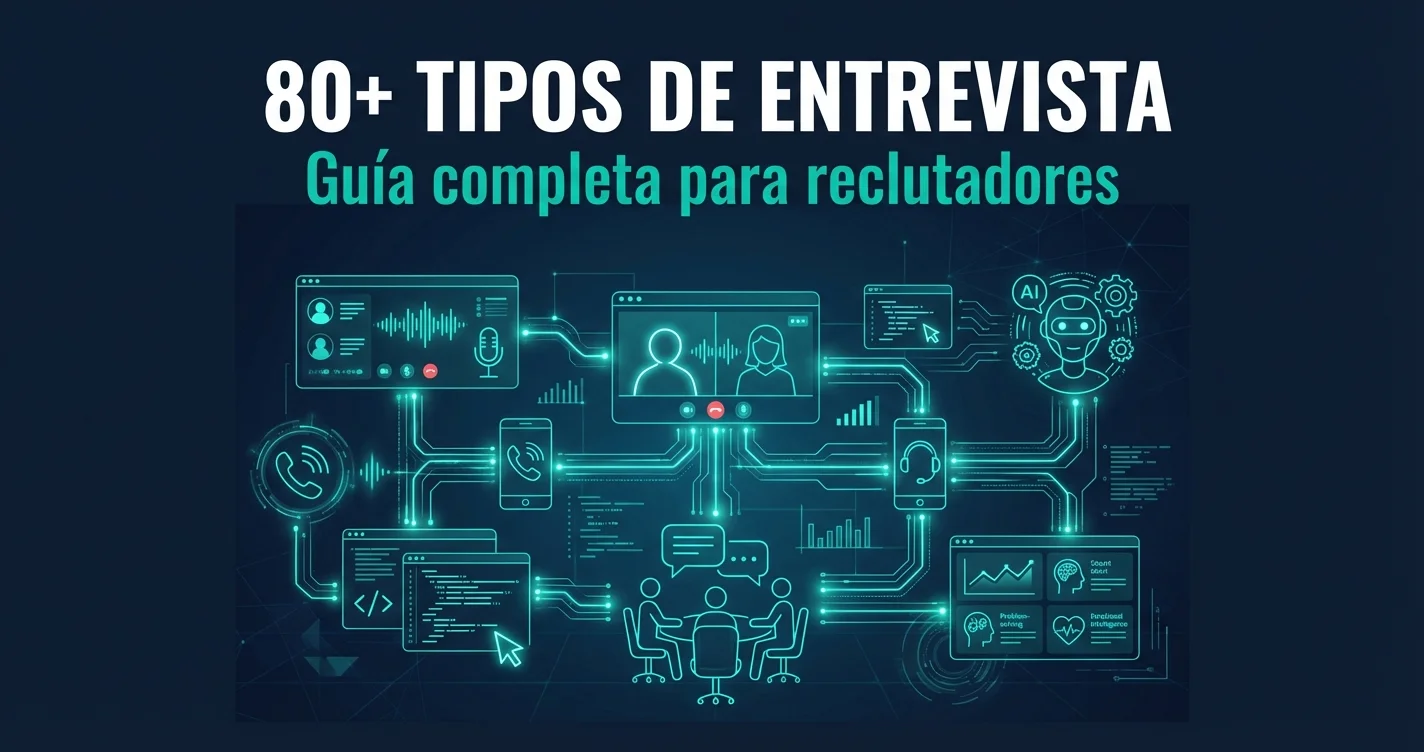
Want to evaluate soft skills in your hiring processes? Skillan offers over 80 types of AI interviews — including evaluations of communication, leadership, problem-solving, critical thinking, and more. Try it free — no credit card required.
Keep reading
- AI candidate screening: step-by-step guide — The complete process from CV upload to the final decision.
- How to analyze CVs with artificial intelligence — The technical process of extraction, semantic evaluation, and automatic ranking.