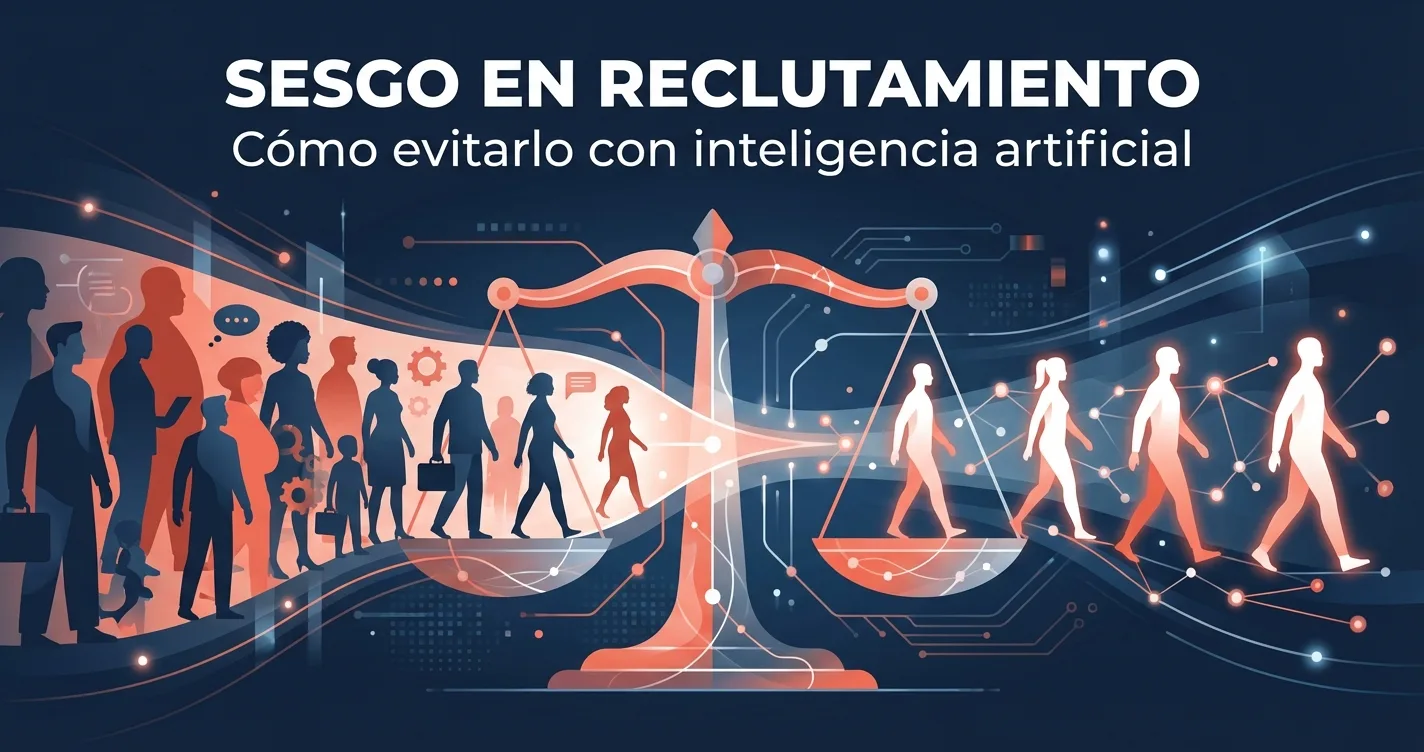
Recruitment bias is the problem nobody wants to admit they have. But the data is clear: Harvard studies show that CVs with Anglo-Saxon names receive 50% more callbacks than identical CVs with Latino or Arab names. In Argentina, an INADI analysis revealed that women over 40 are 63% less likely to advance to an interview than men of the same age with equivalent qualifications.
It's not that recruiters are bad people. It's that the human brain processes 11 million bits of information per second, but only 50 consciously. The rest — including decisions about who "looks like" a good candidate — runs through mental shortcuts we call unconscious biases.
The result: hiring processes that eliminate valuable talent before giving them a chance, homogeneous teams that think alike (and therefore innovate less), and organizations that talk about diversity but always hire the same profile.
Artificial intelligence doesn't eliminate bias entirely — no tool does — but it can drastically reduce it in the stages where it causes the most damage. In this guide, I'll explain which biases affect your process, where they occur, and how to use AI to build a fairer hiring flow.
Contents
- The 8 biases that most affect hiring
- Where bias occurs in your hiring process
- How AI reduces bias at each stage
- Blind CV screening: the first objective filter
- AI interviews: evaluation without prejudice
- Diversity metrics: what you should be measuring
- Common mistakes when trying to reduce bias
- The real cost of recruitment bias
- FAQ about bias and AI-powered recruitment
The 8 biases that most affect hiring
Before solving a problem, you need to understand it. These are the cognitive biases that distort hiring decisions most frequently.
1. Affinity bias
The most common and hardest to detect. You prefer candidates who resemble you: same university, same neighborhood, same interests, same way of speaking. It's not malice — it's neurology. The brain interprets familiarity as trust.
Real example: An IT manager who graduated from a specific engineering school systematically advances candidates from that same school over candidates from other universities with better qualifications. He doesn't do it on purpose. He doesn't even notice.
2. Halo effect
One positive characteristic makes the entire candidate seem positive. The candidate came from Google — so they must be brilliant at everything. The candidate speaks excellent English — so they must be organized and efficient.
A study from the University of Toledo found that interviewers decide whether they like a candidate within the first 10 seconds of the handshake. The rest of the interview is confirmation theater.
3. Confirmation bias
You form a first impression and spend the rest of the process looking for evidence that confirms it. If you liked the CV, during the interview you interpret ambiguous responses favorably. If you didn't, you do the opposite.
4. Gender bias
Still endemic. Research shows the same traits are described differently depending on gender: an "assertive" man is an "aggressive" woman. A "detail-oriented" man is an "overly meticulous" woman. This affects both CV reading and interview evaluation.
5. Age bias (ageism)
Candidates over 45 face an invisible barrier. They're assumed to be "less adaptable to technology," "too expensive," or "won't fit in with a young team." At the same time, very young candidates are discarded for "lack of experience" even when the role doesn't require it.
6. Anchoring bias
The first information you receive about a candidate anchors your entire evaluation. If the first thing you see is the university, that defines your expectation. If it's their last employer, that becomes the frame of reference. The order of information shouldn't matter — but it does.
7. Contrast bias
You evaluate a candidate in comparison to the previous one, not against job requirements. If you interviewed three mediocre candidates and the fourth is merely decent, you perceive them as excellent. If the previous one was brilliant, a good candidate seems poor.
8. Name/origin bias
It's brutal and well-documented. A CV with the name "Santiago Garcia" gets more responses than the same CV with the name "Jose Mamani" or "Muhammad Ali." It happens in Argentina, it happens in the United States, it happens in Europe. And it happens even when recruiters genuinely believe they don't discriminate.
Where bias occurs in your hiring process
Bias doesn't only appear in interviews. It's present at every stage of the funnel, from the job posting to the final offer.
Job ad writing
The words you use in the posting already filter candidates. Textio studies analyzing 10 million job postings found that ads with terms like "competitive," "aggressive," "rockstar" receive 26% fewer applications from women. Terms like "collaborative," "team," "growth" attract more diverse applications.
CV reading
This is where the damage is massive due to volume. If your team reads 200 CVs for a search, bias gets multiplied 200 times. After the first 30-40 CVs, decision fatigue sets in and mental shortcuts intensify. The recruiter starts filtering by university, previous employer, CV format — any quick proxy that doesn't necessarily correlate with performance.
Interviews
The most vulnerable point in the process. The interviewer has 30 to 60 minutes to form an opinion about someone. Affinity, halo, and confirmation biases operate at maximum power. Without a structured question guide, each candidate receives a different interview — making objective comparison impossible.
Evaluations and scoring
Even with rubrics, bias infiltrates interpretation. A "4 out of 5" for one evaluator is a "3 out of 5" for another. Without criteria anchored to concrete behavioral examples, scores are subjectivity disguised as objectivity.
Final decision
The selection committee's "gut feeling" is the last bias filter. "I'm not totally sold," "I don't see them on the team," "I feel like they don't fit" — these are all ways of saying "I can't articulate what bothers me, but my unconscious bias says no."
How AI reduces bias at each stage
AI doesn't have "gut feelings." It doesn't care what the candidate's name is, which university they attended, or how old they are. It evaluates what you ask it to evaluate, with the criteria you define, consistently for all candidates.
Does that make it perfect? No. AI can inherit biases from the data it was trained on. But unlike a human, those biases can be audited, measured, and corrected. A recruiter's unconscious bias is invisible — an algorithm's bias is detectable and fixable.
Let's see how it works at each stage.
In job ad writing
AI tools can analyze your posting text and flag terms that discourage applications from certain groups. It's not just replacing "rockstar" with "professional" — it's detecting subtler patterns like inflated requirements that unnecessarily screen out diverse candidates.
In CV reading
This is where AI has the biggest impact. An AI screening system can evaluate 200 CVs in minutes, applying the same criteria to each one, without fatigue, without anchoring on the name, without being impressed by the logo of the last employer.
The trick is in defining the criteria well. If you tell AI to filter by "prestigious university," it will reproduce the socioeconomic bias that already exists. But if you ask it to evaluate technical skills, relevant experience, and concrete achievements — regardless of where they studied or worked — the result is radically fairer.
If you're still filtering CVs manually, check how to analyze CVs with AI to understand the shift involved.
In interviews
An AI voice interview asks exactly the same questions to all candidates, in the same order, with the same tone. It doesn't get tired, doesn't get distracted, doesn't have a bad day. It evaluates responses against predefined criteria — argument structure, information relevance, communication clarity — without factors like appearance, accent, or attire playing a role.
This doesn't replace the final human interview. It complements it. If you want to go deeper into how these work, read about AI interviews and how to configure them.
In scoring and ranking
Instead of subjective 1-to-5 scores that each evaluator interprets differently, AI generates scores based on criteria anchored to concrete evidence. "The candidate mentioned 3 quantifiable achievements in their leadership experience" is more useful than "I felt they have leadership potential."
Blind CV screening: the first objective filter
Blind screening is the practice of evaluating CVs by removing information that can trigger biases: name, photo, age, gender, university, address. Only experience, skills, and achievements remain.
It's a practice symphonic orchestras implemented decades ago (blind auditions, behind a curtain, increased the hiring of women by 30%). In corporate recruiting, mass adoption is only happening now, and AI makes it enormously easier.
How to implement it in your process
Step 1: Define objective criteria. Before receiving CVs, list the skills, experience, and competencies the role truly needs. Not what would be "nice to have" — what's necessary. Each criterion must be measurable.
Step 2: Configure automated screening. An AI system can process bulk CV uploads and evaluate them solely against your criteria, ignoring demographic data. The output is a ranking based on role fit, not candidate profile.
Step 3: Review results, not CVs. Instead of reading individual CVs, review the ranking and scores. Decide who advances based on scores, not your impression of the document.
Step 4: Reveal identity only at the interview stage. The candidate stops being anonymous when they reach the human stage — which is where your personal judgment adds real value.
Documented results
Companies that implemented blind screening report:
- 46% more diversity in candidates advancing to interviews (Applied study)
- 16% improvement in quality of hire measured at 12 months (Deloitte)
- 35% less time in the initial filtering stage (by eliminating subjective deliberation)
AI interviews: evaluation without prejudice
Traditional interviews are the weakest link when it comes to bias. Even experienced recruiters are vulnerable. A Google study (Project Oxygen) found that unstructured interviews are barely better than a coin flip at predicting job performance.
AI interviews address this in three ways:
Absolute standardization
Every candidate receives the same questions, in the same format, with the same response time. There are no "bonus questions" for candidates the interviewer likes or easier questions for those who generate empathy.
If you need to evaluate soft skills like communication and critical thinking, AI can include situational and behavioral questions designed specifically for that — applied identically to everyone.
Criteria-based evaluation, not impression-based
AI doesn't generate a "feeling" about the candidate. It generates a structured analysis: what they said, how they structured it, what evidence they presented, what they omitted. The results reports show exactly why each candidate received a particular score.
No visual variables
In a voice interview with AI, the candidate's physical appearance is irrelevant. There's no bias from clothing, tattoos, weight, visible disabilities, ethnic features, or apparent age. Only what they say and how they say it counts.
Diversity metrics: what you should be measuring
You can't reduce what you don't measure. These are the indicators that reveal whether your process has bias — or whether you're improving.
Conversion ratio by stage and demographic group
Measure what percentage of candidates from each group (gender, age, origin) advances from one stage to the next. If 40% of applicants are women but only 15% reach interviews, you have a biased bottleneck.
| Stage | % women advancing | % men advancing | Gap |
|---|---|---|---|
| CV → Screening | 38% | 52% | -14% |
| Screening → Interview | 22% | 35% | -13% |
| Interview → Offer | 45% | 43% | +2% |
This hypothetical example shows something common: bias is in CV filtering and in who reaches interviews. Once there, the evaluation is more balanced. That's exactly where automated screening can intervene.
Average score by group
If your female candidates average 7.2 and male candidates 6.8 in AI evaluations but men receive more offers, the bias is in the final human decision, not in the filter.
Time in process by group
Candidates from certain groups take longer to receive responses, get interviews scheduled later, or remain "on hold" longer. Measuring times by group reveals unconscious team preferences.
Effective hiring diversity
The bottom-line indicator: is your team becoming more diverse? Measure it quarter over quarter. If it's not moving, your anti-bias interventions aren't working.
Common mistakes when trying to reduce bias
Believing unconscious bias training is enough
"Unconscious bias" workshops are popular, but the evidence on their effectiveness is, at best, mixed. A meta-analysis of 492 studies found that unconscious bias training may improve awareness but doesn't change behavior in a sustained way. Knowing you have biases doesn't prevent you from acting on them.
What does work: changing the process so bias can't operate. Blind screening, structured interviews, predefined criteria, and AI as the first filter are structural interventions, not just awareness ones.
Implementing quotas without changing the process
If your hiring process has built-in bias and you layer a diversity quota on top, all you achieve is hiring diverse candidates who survived an unfair process. That creates two problems: you lose diverse talent that was filtered out unfairly, and the candidates who do pass face the perception that they "got in through the quota."
Fix the process first. Diversity comes as a natural consequence of fair selection.
Trusting that "we don't discriminate"
The most dangerous phrase in recruitment. Everyone discriminates — it's neurology, not morality. The difference is between those who admit it and build processes to mitigate it, and those who deny it and let it operate freely.
Using AI without auditing the model
If the AI was trained on historically biased hiring data ("in the last 10 years we hired 80% men for technology roles"), it will reproduce that pattern. AI isn't magically fair — it's fair if the criteria you give it are fair and if you audit its results regularly.
Measuring only at the end of the process
If you measure diversity only in the final hire, you see the result but not the cause. Measure at each stage of the funnel to find exactly where diversity is lost. Often, the biggest bias filter isn't the interview — it's CV reading.
The real cost of recruitment bias
Bias isn't just an ethical problem. It's a business problem with concrete numbers.
Cost of lost talent
If your process eliminates 30% of good candidates due to bias (name, age, university), you're fishing in a smaller pool. For a team of 50 that hires 15 per year, that's 4-5 suboptimal hires annually — because the best candidate was discarded before reaching the interview.
Cost of homogeneity
A McKinsey study of 1,000 companies across 15 countries found that companies in the top quartile for ethnic and gender diversity are 36% more likely to outperform their competitors in profitability. Homogeneity isn't just unfair — it's less profitable.
Cost of turnover
When you hire for "cultural fit" (which is often code for "looks like us"), you build a comfortable but fragile team. Employees who don't fit the mold leave sooner, generating turnover costs that average 50-200% of annual salary depending on the role level.
Let's do the numbers
| Concept | Without bias management | With AI + blind screening |
|---|---|---|
| CVs evaluated/search | 200 | 200 |
| Candidates lost to bias | ~60 (30%) | ~10 (5%) |
| Actual talent pool | 140 | 190 |
| Shortlist diversity | 18% | 41% |
| Turnover at one year | 25% | 14% |
| Turnover cost/position (USD) | $12,000 | $12,000 |
| Annual savings (team of 50) | — | $16,500 |
If you're already optimizing time to hire with AI, reducing bias is the multiplier that supercharges the entire process.
FAQ about bias and AI-powered recruitment
Can AI be biased too?
Yes. If the model was trained on historically biased data, it reproduces those patterns. The key difference: an algorithm's bias can be systematically audited, measured, and corrected. A human's bias is invisible and varies with mood, time of day, and personal affinity.
Doesn't blind screening complicate "cultural fit" evaluation?
Cultural fit is legitimate but misused. What matters is whether the candidate shares the organization's values (teamwork, transparency, results orientation) — not whether they went to the same university or share the same hobbies. Blind screening doesn't eliminate cultural evaluation; it postpones it to the stage where it makes sense: the human interview.
How much does it cost to implement a bias-free hiring process?
Screening and AI interview tools like Skillan start from USD $79/month. Compare that with the cost of a bad hire (USD $12,000-$30,000) or a discrimination lawsuit. For detailed plans, check the options on the pricing page.
Are companies in LATAM adopting these practices?
Increasingly so. Brazil leads with active anti-discrimination legislation in hiring processes. Argentina, Colombia, and Mexico are following. Multinationals operating in LATAM already require diversity metrics from their local HR teams. Those who don't adapt lose talent and lose clients.
Does reducing bias lower hiring "quality"?
Quite the opposite. Bias is noise in the signal. When you remove it, the signal is clearer: you see who's truly the better candidate instead of who most resembles the last person you hired. Companies that implement blind screening report 12-16% improvements in performance metrics at 12 months.
Good intentions aren't enough
Recruitment bias isn't solved with good will. It's solved with processes that don't give it room to operate. Blind CV screening, standardized AI interviews, predefined criteria, and metrics at every stage of the funnel.
It's not perfect. No system is. But an imperfect and measurable process is infinitely better than an invisible and uncontrolled one.
If you want to start building a fairer — and more effective — hiring process, try Skillan free. No credit card required, with full access to AI screening and voice interviews.
Keep reading
- How to evaluate soft skills with artificial intelligence — The perfect complement: evaluate soft skills objectively to complete the candidate picture.
- AI candidate screening: step-by-step guide — The previous step: automate CV filtering with objective criteria before the interview.