Time to hire is the metric that separates growing consulting firms from stagnant ones. This isn't an exaggeration: when you take 35 days to fill a position that your competitor fills in 12, you don't just lose the candidate — you lose the client.
And the problem isn't that recruiters are slow. It's that the process has structural bottlenecks that no human effort can resolve. Reading 200 CVs takes days. Coordinating screening interviews with 20 candidates takes a week. Waiting for client feedback takes another. And while all that happens, the best candidates accept another offer.
Artificial intelligence doesn't solve everything. It won't make your client respond faster. But it does eliminate the bottlenecks that depend on you — and those represent 60% to 70% of the total process time.
In this article, I'll show you where time is really lost, what AI can automate at each stage, and how to go from weeks to days without sacrificing selection quality.
Contents
- Anatomy of time to hire: where the days go
- The 4 stages AI can compress
- Stage 1: CV screening — from days to minutes
- Stage 2: Initial interviews — from weeks to hours
- Stage 3: Evaluation and shortlist — from hours to instant
- Stage 4: Client presentation — from days to same day
- Case study: the same process with and without AI
- What AI CANNOT speed up (and what to do about it)
- 5 metrics to measure real impact
- How to start reducing timelines today
- FAQ
Anatomy of time to hire: where the days go
Before looking for solutions, you need to understand the problem. The average time to hire in Latin America ranges between 25 and 45 days depending on industry and role level. But that number hides the reality of how time is distributed.
Let's break down a typical process for a consulting firm handling a mid-level search with 150 candidates:
Receiving and reading CVs: 3-5 days. You receive applications during the first week. You read each CV, do an initial classification, separate the ones that seem relevant. With 150 CVs at 18 minutes each, that's 45 hours of pure reading — more than a full week of work for a recruiter dedicated exclusively to that.
Phone screening: 5-7 days. You selected 25 candidates and need to make initial contact. Call, schedule, conduct the 15-20 minute interview, take notes. With luck you manage 6-8 calls per day between failed attempts, rescheduling, and the interviews themselves.
Evaluation and shortlist assembly: 2-3 days. You compare notes, review profiles, build the shortlist of 5-8 candidates. This involves going back and forth between CVs, interview notes, and the job description.
Client presentation and feedback: 3-7 days. You send profiles, wait for them to be reviewed, receive feedback, adjust if needed. This stage depends mostly on the client, but you also add time if you send profiles late or poorly presented.
Client interviews and decision: 5-10 days. The client interviews finalists. Here you depend on other people's schedules.
Actual total: 18-32 days in the best case. And that's without counting delays like vacations, unresponsive candidates, or profile changes mid-process.
The important thing to note is that the first three stages — CV reading, phone screening, and evaluation — are the ones you control. And they're exactly the ones AI can compress.
The 4 stages AI can compress
Not all AI is the same, and not all of it applies to the same stages. What you need to reduce time to hire is a combination of three capabilities:
Massive CV processing. You upload 150 CVs and in minutes each one is analyzed, with data extracted and a score against job requirements. If you want to understand this process in depth, the guide on AI candidate screening explains it step by step.
Automated voice interviews. Instead of calling 25 candidates one by one, you send them a link. Each candidate interviews with the AI when it's convenient — could be 10 AM or 11 PM. The AI generates a report with scoring and recommendations.
Automatic comparative reports. Instead of building manual spreadsheets, the platform generates a dashboard with all candidates compared, their CV scores, interview scores, and recommendations.
Let's see how this applies at each stage.
Stage 1: CV screening — from days to minutes
Without AI: 3-5 days (45+ hours for 150 CVs). With AI: Minutes of processing + 2-3 hours reviewing the best profiles.
AI screening isn't just faster. It's more consistent. A recruiter reading CV number 130 doesn't evaluate with the same rigor as CV number 5. AI does.
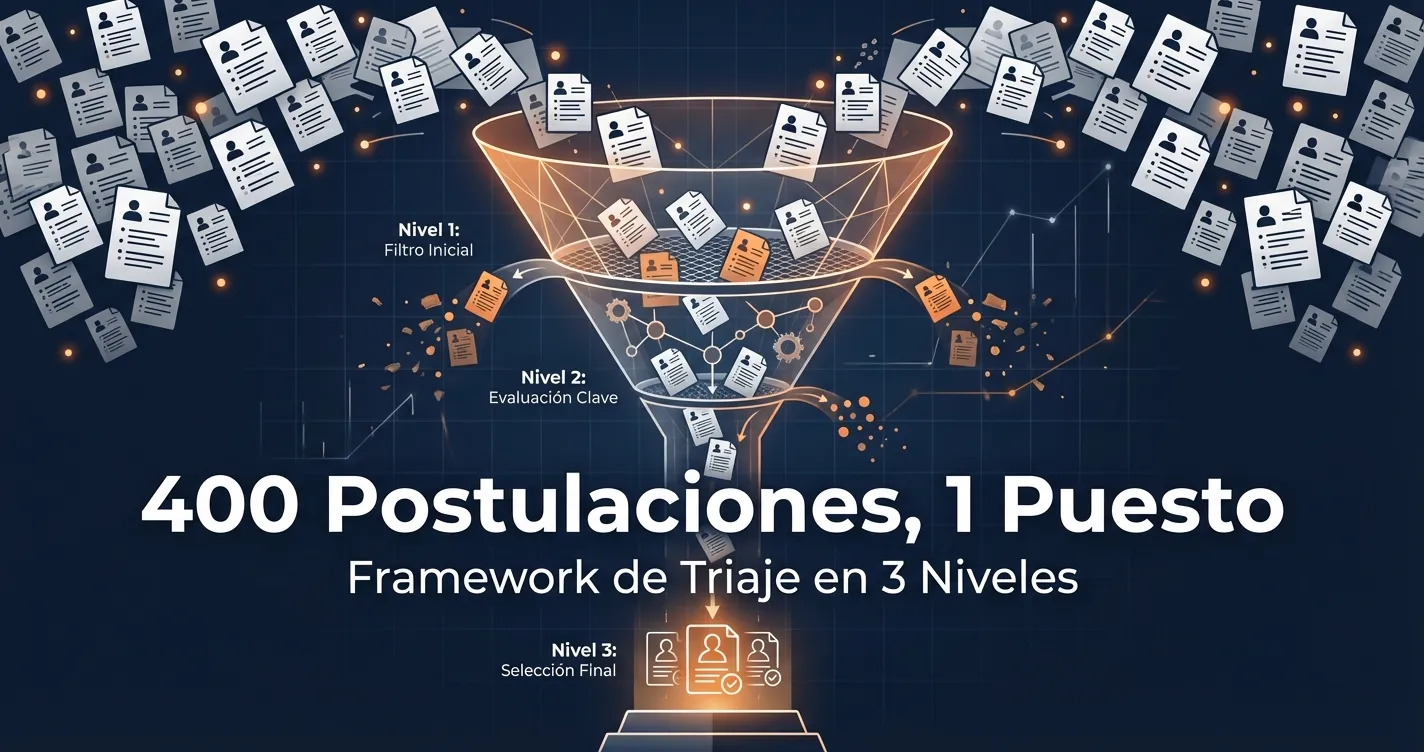
The process is straightforward: upload all CVs at once (bulk upload, drag & drop), AI processes them, extracts data, cross-references against requirements, and presents a ranking. Instead of reading 150, you review the top 20 — which already come with a breakdown of why they're ranked at the top.
Net savings: between 35 and 40 hours per search.
But time savings aren't the only benefit. With manual screening, good candidates slip through because their CV has an unusual format or their relevant experience isn't highlighted. AI reads everything in every CV and doesn't get tired. The guide on how to analyze CVs with AI dives into how this extraction and semantic evaluation works.
Stage 2: Initial interviews — from weeks to hours
Without AI: 5-7 days (coordinating + conducting 20-25 phone interviews). With AI: 24-48 hours (candidates interview on their own, whenever they want).
This is the stage where AI has the most dramatic time impact. Not because the interview itself is shorter, but because you eliminate three enormous friction points:
You eliminate coordination. No back-and-forth of "does Tuesday at 3 work?" via email or WhatsApp. You send the candidate a link and that's it. They interview when it's convenient.
You eliminate dependency on your schedule. AI interviews at 7 AM, at midnight, on holidays, on Saturdays. It has no calendar. If a candidate gets the link at 10 PM and wants to do it right then, they can.
You eliminate sequentiality. You can only do one interview at a time. AI can interview 20 candidates simultaneously. There's no queue.
The result: instead of a week of calls, within 24-48 hours most candidates have already been interviewed. And you didn't invest a single minute doing it — you receive the reports ready for review.
And these aren't generic interviews. Advanced platforms offer over 80 specialized interview types: technical, language, situational, soft skills, role-specific. The AI adapts questions to the role profile and evaluates responses in context. If you're interested in soft competency evaluation, the article on how to evaluate soft skills with AI goes into detail.
Stage 3: Evaluation and shortlist — from hours to instant
Without AI: 2-3 days (comparing CVs, notes, building a spreadsheet). With AI: Instant (the dashboard already has everything compared).
With manual screening and interviews, building the shortlist is an exercise in memory and organization. You have CVs in one folder, interview notes in another, and need to mentally cross-reference everything to decide who advances.
With AI, this stage practically disappears as a separate task. When interviews are done, you already have a dashboard with each candidate showing their CV score, interview score, strengths, areas for improvement, and system recommendation.
Your work is reduced to looking at the ranking, validating the top candidates, and assembling the shortlist. Instead of hours comparing spreadsheets, it's 30 minutes of informed review.
Stage 4: Client presentation — from days to same day
Without AI: 1-3 days (building reports, formatting, sending). With AI: Same day (reports are already generated).
When your client asks "send me the 5 best candidates with a summary of each," you normally sit down to build a document: copy data from the CV, summarize interview notes, format everything to look professional. That's hours of administrative work.
With an AI system, each candidate's reports are already generated. The screening produced a CV analysis with score and breakdown. The AI interview produced a report with evaluation, strengths, areas for improvement, and recommendation. You just need to select the candidates and share access — or export the reports.
The impact isn't just about time. It's about professional perception. When you send the client a structured report with concrete data the same day you closed sourcing, your firm is perceived as an efficient machine. And that retains clients.
Case study: the same process with and without AI
Let's imagine a real search: a consulting firm needs to fill a Senior Commercial Analyst position for a retail client. They receive 180 applications.
Without AI
| Stage | Time | Recruiter-hours |
|---|---|---|
| Reading 180 CVs | 4 days | 54 hours |
| Phone screening (30 candidates) | 6 days | 12 hours |
| Evaluation and shortlist | 2 days | 6 hours |
| Building reports for client | 1 day | 4 hours |
| Subtotal (controllable stages) | 13 days | 76 hours |
With AI
| Stage | Time | Recruiter-hours |
|---|---|---|
| CV upload + AI processing | Minutes | 0.5 hours |
| Ranking review (top 30) | Same day | 3 hours |
| AI interviews (30 candidates) | 1-2 days | 0 hours |
| Interview report review | Same day | 2 hours |
| Client presentation | Same day | 0.5 hours |
| Subtotal (controllable stages) | 2-3 days | 6 hours |
Savings: 10 days and 70 hours per search. If you handle 10 searches per month, that's 100 days and 700 hours monthly. That's the difference between needing 4 recruiters and needing 1.
What AI CANNOT speed up (and what to do about it)
Being honest about limitations is important. AI compresses the stages that depend on your team, but there are parts of the process it doesn't control:
Client response time. If your client takes a week to review the shortlist, AI can't do anything about it. What you can do: present candidates the same day (because with AI you can), which reduces their excuse of "I didn't have time to look at them." And AI-generated reports are easier to digest than an email with attached CVs.
Schedule availability for final interviews. Coordinating interviews between the candidate and hiring manager still depends on human calendars. But by compressing the previous stages, you've gained days of margin that absorb these delays.
Negotiation and closing. The offer, the counter-offer, the candidate's notice period — all of this is human and doesn't get automated. But arriving at this stage in 5 days instead of 25 means the candidate is still enthusiastic and hasn't accepted another offer while waiting.
Profile changes mid-process. If the client redefines what they're looking for after seeing the first candidates, recalibration is needed. The advantage with AI: recalibrating takes minutes (adjust requirements and reprocess), not days.
5 metrics to measure real impact
Reducing time to hire isn't an abstract goal. You need to measure it to know if it works and to justify the investment in technology. These are the 5 metrics that matter:
1. Time to shortlist
Time from receiving applications to presenting the shortlist to the client. It's the metric that most directly reflects your internal efficiency. Benchmark: with AI, should be 2-3 days. Without AI, typically 10-15 days.
2. Total time to hire
Time from opening the search to the candidate accepting the offer. This includes stages you don't control, but your part should have dropped drastically. Benchmark: 40-60% reduction in total time.
3. Candidates processed per recruiter-hour
How many CVs you can evaluate per hour of team work. It's the pure productivity metric. Benchmark: with AI, a recruiter processes 10-20x more candidates per hour than manually.
4. Shortlist acceptance rate
What percentage of candidates you present advance to client interviews. If AI does the screening well, this rate should go up — because you're presenting more precisely matched candidates. Benchmark: 70-80% of candidates in your shortlist should advance.
5. Cost per hire
Includes recruiter time, software licenses, job board postings, and any other expense. With AI, recruiter-hour costs drop, which should reduce total cost even after adding the software license.
How to start reducing timelines today
You don't need to transform your entire process overnight. The most practical way to start:
Week 1: Automate CV screening. Pick an active search with good candidate volume. Upload all CVs to an AI platform, compare the ranking against your manual evaluation. Calibrate.
Week 2: Add AI interviews. For candidates who passed screening, instead of calling, send AI interview links. Review reports and compare with your usual phone interviews.
Week 3: Measure. Compare the time to shortlist for this search against your historical average. Measure recruiter-hours invested. Calculate savings.
Week 4: Scale. If the numbers work, apply to all active searches.
The risk of trying is zero: you're not replacing anything, you're adding a tool. Your candidates are still there, your process still works, and you can directly compare results.
FAQ
Does reducing time to hire affect candidate quality?
Quite the opposite. Manual screening under time pressure leads to shortcuts: skimming CVs, discarding by format, not interviewing everyone you should. AI eliminates those shortcuts because it processes everything. You're faster AND more thorough at the same time.
How much does time to hire actually decrease in practice?
The stages you control (screening, initial interviews, evaluation) compress by 70% to 85%. Total time to hire, including client stages, typically reduces by 40% to 60%.
Does it work equally for high-volume searches and executive positions?
The impact is greater in high volume, where time savings are more dramatic. For executive positions with few candidates, the value is more in the depth of analysis (specialized AI interviews, competency evaluations) than in raw time savings.
Do candidates accept being interviewed by AI?
The completion rate for AI interviews is comparable to phone interviews, with the advantage that the candidate chooses when to do it. Initial resistance exists but drops quickly when the experience is a natural voice conversation and not a form.
Do I need to change my ATS to use AI in the process?
Not necessarily. Many AI recruitment platforms work independently or integrate with existing ATS systems. You can add AI as an additional layer without replacing what you already use.
Conclusion
Time to hire isn't just an operational metric. It's your competitive advantage as a consulting firm. In a market where the best candidates are available for days — not weeks — getting there first means getting there better.
AI doesn't make you a faster recruiter. It frees you from the tasks that made you slow: reading CVs one by one, coordinating calls, building spreadsheets, formatting reports. When that disappears, what remains is your judgment, your client relationship, and your ability to close — which are the things that actually generate value.
Going from 30 days to 10 doesn't require a bigger team. It requires a smarter process.
Want to see how much time you can save? Skillan automates CV screening and initial AI interviews. Try it free — no credit card required.
Keep reading
- AI candidate screening: step-by-step guide — How to process hundreds of CVs in minutes and generate automatic rankings.
- How to analyze CVs with artificial intelligence — The technical process of CV extraction, evaluation, and scoring.
- How to evaluate soft skills with AI — Communication, leadership, and critical thinking measured with AI voice interviews.