A recruiter who always uses the same type of interview is leaving information on the table. The classic structured interview works for some roles, but it tells you nothing about how a candidate reacts under pressure. A technical interview is essential for a developer, but irrelevant for a salesperson. A competency-based interview reveals past behavior patterns, but doesn't predict how someone will perform in a new context.
The problem isn't that there are too many types of interviews. The problem is not knowing which one to use, when to combine them, and what to expect from each.
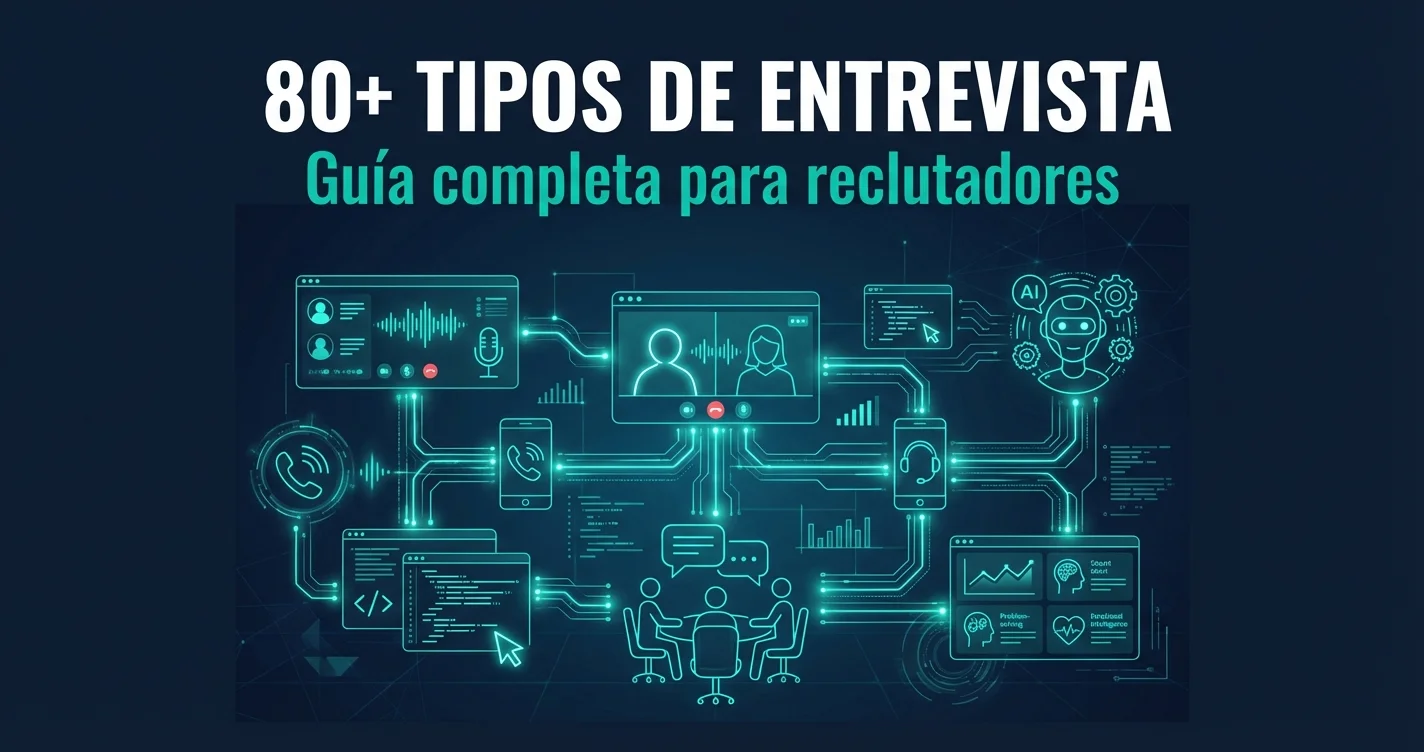
This guide covers the 11 main categories of interviews for hiring — over 80 types in total — with clear criteria for when to use each one, what questions to ask, and which roles they work best for. At the end, I also explain how AI is changing the time all of this takes.
Contents
- Why the type of interview you choose defines the quality of your hire
- 1. Initial screening interviews
- 2. Technical interviews
- 3. Competency-based interviews
- 4. Situational interviews
- 5. Language interviews
- 6. Soft skills interviews
- 7. Psychological interviews
- 8. Cognitive interviews
- 9. Cultural fit interviews
- 10. Software skills interviews
- 11. Certification and technical-theoretical knowledge interviews
- How to combine interview types in a real hiring process
- How AI is transforming hiring interviews
- Frequently asked questions about interview types
Why the type of interview you choose defines the quality of your hire
The interview is the most widely used tool in hiring and also the least standardized. Every recruiter has their own style, their favorite questions, their intuition. That's not necessarily bad. The problem appears when the interview type isn't aligned with what you need to measure.
If you're hiring someone for a customer service role and only ask them about their work history, you're evaluating what they did — not how they'll handle a difficult customer at 5 PM on a Friday. If you need a data analyst and don't include any technical exercise, you're betting that what they say on their resume reflects what they can actually do.
Studies on the predictive validity of interviews are clear: unstructured interviews have a 0.38 correlation with job performance. Structured interviews combined with skills assessments go up to 0.63. That's not a marginal difference — it's the difference between hiring well 38% of the time versus 63%.
The right type of interview also gives the candidate a better experience. A well-designed technical interview for a senior developer shows that your company understands the role. An honest cultural fit interview — where questions go both ways — generates more candidates who accept the offer.
With that said, let's look at the 11 categories.
1. Initial screening interviews
What they are and when to use them
Screening interviews are the first human filter after resume analysis. Their goal isn't to go deep — it's to confirm basic information, verify availability, align salary expectations, and decide whether the candidate moves to the next stages.
They generally last between 10 and 20 minutes. They can be conducted by phone, video call, or increasingly, by AI.
Main types
Phone screening. The most traditional format. Useful for verifying data, reviewing salary expectations, and asking knockout questions (Are you available to start immediately? Would you accept in-office work in X area?).
Video call screening. Adds the visual dimension, useful for roles where presence or non-verbal communication matters.
Asynchronous screening. The candidate answers recorded questions on video or audio without a real-time interviewer. They're reviewed when the recruiter is available.
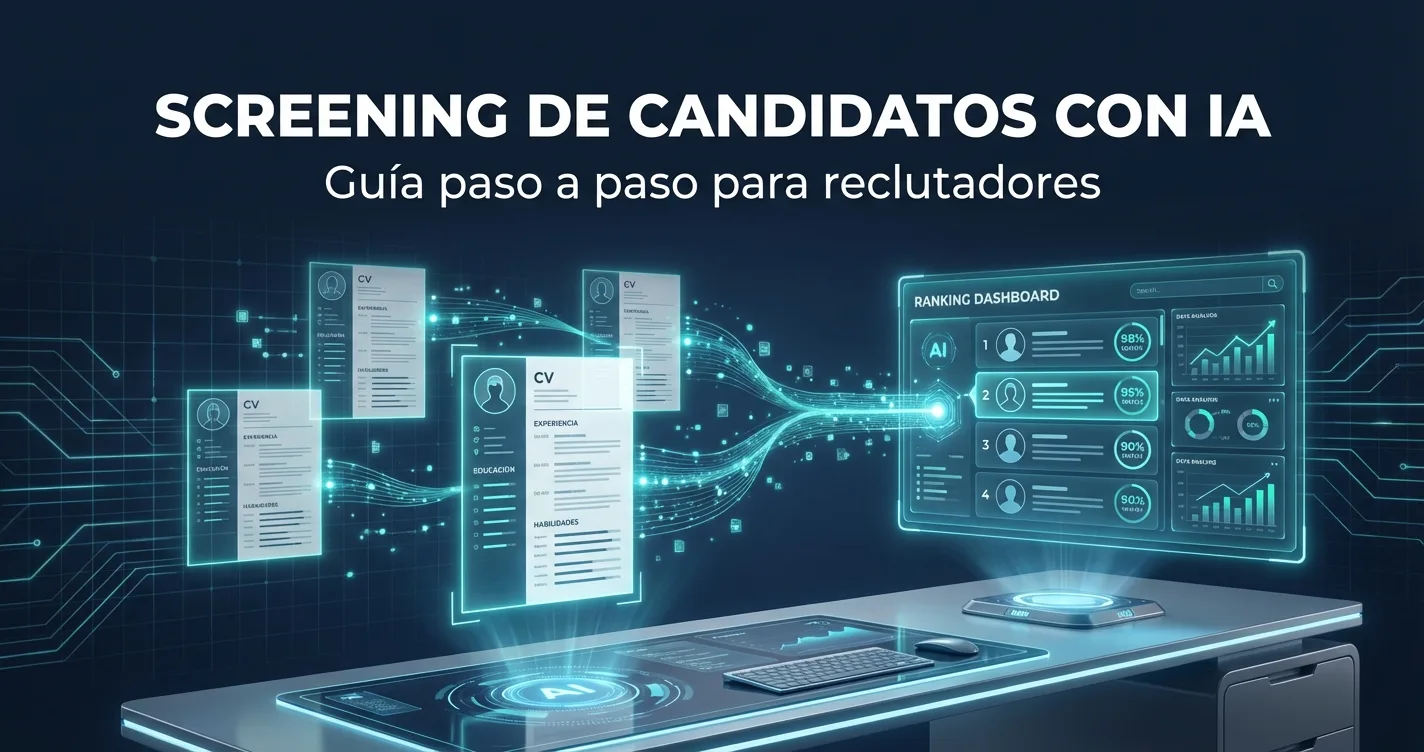
AI screening. An AI system conducts the initial interview by voice, asks screening questions, evaluates the answers, and generates a report. The candidate interviews whenever they want — at any time, on any day. The recruiter receives a report with a score and recommendation.
Which roles it works best for
Applicable to virtually all roles, especially when candidate volume is high. For high-volume searches (dozens or hundreds of applications), AI screening is the only method that scales without multiplying the team's hours.
Practical tip
Define your knockout questions in advance — the ones where, if the answer is "no," the conversation ends. Availability, salary range, work modality, relocation requirements. If you include them at the beginning, you don't waste 15 minutes to reach a rejection that could have taken 2.
If you're already working with AI candidate screening, you arrive at this stage with pre-filtered candidates. The initial screening becomes shorter and more focused because you already know the basic technical profile is covered.
2. Technical interviews
What they are and when to use them
Technical interviews evaluate domain-specific knowledge — programming, finance, engineering, medicine, design, accounting. They are essential for any role where technical know-how is a core requirement, not optional.
The most common mistake is using them too late in the process. If a candidate reaches the fifth round before anyone asks them a technical question, and it turns out they don't know what they should know, you've wasted weeks.
Main types
Technical interview with theoretical questions. The interviewer asks conceptual questions: How does an index work in SQL? What's the difference between inheritance and composition in OOP? It evaluates the candidate's depth of understanding in their area.
Live coding. The candidate solves a programming problem in real time — on a whiteboard, in a shared editor, or on a specialized platform. It evaluates the way they think, not just the result.
Take-home challenge. The candidate is given a problem to solve at home, usually with a 24-72 hour deadline. It reduces the pressure of the environment but requires later verification that the work is their own.
Pair programming. The candidate works alongside a technical team member on a real or simulated problem. More time-consuming but very revealing of working style.
Portfolio review. For designers, architects, writers, creatives. The candidate presents their previous work and explains the decisions behind each piece.
Technical case study. For analysis, strategy, and finance roles. The candidate is presented with a dataset, a business, or a situation and asked for an analysis or recommendation.
Which roles/industries it works best for
Tech (development, data, infrastructure), finance, engineering, design, health sciences, legal, and any role where technical errors have real consequences.
Practical tip
Design technical problems based on the actual work the candidate will do, not on what's easy for you to evaluate. A complex algorithms exercise for a developer who will be doing basic CRUD generates false negatives. A consultative selling exercise for an SDR who will be doing cold calling does too.
3. Competency-based interviews
What they are and when to use them
Competency-based interviews — also called behavioral interviews or STAR (Situation, Task, Action, Result) — are based on a simple principle: past behavior is the best predictor of future behavior.
Instead of asking "how would you handle a difficult client?" (hypothetical), you ask "tell me about a time you had to handle a difficult client" (real). The answer reveals how the candidate actually acted in the past, not how they think they would act in the future.
Main types
Structured STAR interview. Each question targets a specific competency, and the candidate is expected to answer using the Situation-Task-Action-Result framework. The interviewer can dig deeper with follow-up questions.
Role-specific competency interview. The company maps the key competencies for the role (leadership, results orientation, teamwork, conflict resolution) and designs questions for each one.
Values-based interview. A variation where the questions target behaviors that reflect the organization's values, not just the role's competencies.
Sample questions
- "Tell me about a time you had to deliver a project under heavy time pressure. What did you do and what was the outcome?"
- "When was the last time you had to convince someone to change their position? How did you approach it?"
- "Describe a situation where you made a significant mistake at work. What happened and what did you learn?"
Which roles/industries it works best for
Leadership roles, management, sales, human resources, customer service — any position where interpersonal skills and the ability to make decisions under pressure are critical. For purely technical roles, combine it with a technical interview.
Practical tip
Design a scorecard before the interview with the competencies you're evaluating and the criteria for a weak, average, and strong answer for each one. Without those predefined criteria, you end up comparing candidates subjectively. With the scorecard, the comparison is objective.
4. Situational interviews
What they are and when to use them
Situational interviews are similar to behavioral ones but point to the future instead of the past. The candidate is presented with hypothetical situations relevant to the role and asked how they would act.
They carry more weight when the candidate has no prior experience in the specific role (first-job positions, industry changes) and when you want to evaluate reasoning and values more than concrete experience.
Main types
Standard situational questions. "If a customer calls you furious because their order didn't arrive and it turns out it was the company's mistake, how would you handle it?"
Role play. The interviewer plays the role of the client, the boss, the difficult colleague, and the candidate interacts in real time. Very revealing for sales, negotiation, and customer service roles.
In-basket exercise. The candidate is presented with an inbox full of emails, messages, and problems they would need to resolve on their first day. It evaluates prioritization, decision-making, and time management.
Business case discussion. A complex business situation is presented (a product losing market share, a team with high turnover) and the candidate discusses what they would do.
Which roles/industries it works best for
Sales, management, executive roles, consulting, customer service, positions where judgment and professional ethics are central.
Practical tip
Well-designed situational questions don't have an obvious "correct" answer. If the candidate can intuit what you want to hear and respond accordingly, the question isn't measuring anything. The best situational questions involve a real dilemma with trade-offs.
5. Language interviews
What they are and when to use them
Language interviews evaluate the actual level of oral communication in a language other than the candidate's native one. They are mandatory for any role where the language will be used at work — not as a decorative item on a resume.
The resume says "advanced English" and the candidate has a low-intermediate level. This is one of the most frequent and most costly gaps to detect after hiring.
Main types
Conversational interview. The entire interview (or part of it) is conducted in the required language. It's the most realistic method.
Structured level assessment interview. A formal assessment of the level (A1 to C2) is done with standardized questions per level.
Reading comprehension test. The candidate reads a technical document in the language and answers questions about it.
Oral or written production test. The candidate drafts an email, a report, or a proposal in the required language.
AI interview in the target language. An AI system conducts the interview directly in the target language — English, Portuguese, French — evaluates vocabulary, fluency, pronunciation, and comprehension, and generates a level report.
Most in-demand languages in LATAM
English (first place, far above the rest), Portuguese (especially for roles in companies with operations in Brazil), and to a lesser extent French and German for multinational companies.
Which roles/industries it works best for
Any role in multinational companies, technical support roles, consulting, technology, international operations, and any position where the candidate will communicate with colleagues, clients, or vendors in another language.
Practical tip
Don't delegate language evaluation to the candidate's self-assessment or a list of levels on their resume. A 10-minute interview in the required language tells you more than 10 level certifications. If you don't have someone on the team who can evaluate it, an AI can do it consistently and without accent bias.
6. Soft skills interviews
What they are and when to use them
Soft skills interviews evaluate abilities that a resume can't measure: oral communication, active listening, empathy, leadership, teamwork, conflict resolution, adaptability, time management.
They are the most underestimated type of interview and also the one with the greatest impact on long-term performance. A technically flawless candidate who can't work in a team or communicate ideas clearly is a problem.
Main types
Behavioral interview focused on soft skills. STAR questions specifically targeting communication, leadership, or teamwork.
Group dynamics. Several candidates are brought together and observed while they solve a problem collectively. It reveals natural roles, communication styles, and emergent leadership.
Panel interview. The candidate is interviewed by more than one person at the same time. The pressure and group dynamic reveal how they handle high-demand situations.
AI interview for soft skills. An AI analyzes not just what the candidate says, but how they say it: argument structure, clarity, conciseness, coherence, handling of uncertainty. This analysis is consistent across candidates, unlike human evaluation that varies with the interviewer's mood.
Which roles/industries it works best for
All client-facing roles, leadership, management, education, sales, human resources. Also critical for highly collaborative roles even if they're technical (tech leads, product managers, analysts who work cross-functionally).
Practical tip
Define which soft skills are truly critical for the role before designing the questions. "Communication" is too broad — do you need them to write well, present well to executives, or handle difficult customers on the phone? The specificity of what you're evaluating determines the quality of the questions. To dive deeper into how to measure these skills with modern tools, read the guide on how to evaluate soft skills with AI.
7. Psychological interviews
What they are and when to use them
Psychological interviews — generally conducted by psychologists or HR specialists — evaluate aspects of personality, emotional structure, stress response mechanisms, motivation, and the candidate's maturity.
They go deeper than competency and soft skills interviews. While the latter evaluate concrete behaviors, the psychological interview tries to understand the why behind those behaviors.
Main types
Psycho-occupational interview. The most common in HR. It evaluates work aptitudes, workplace relationship patterns, authority management, and frustration tolerance.
Projective tests. Tools like the Rorschach, the TAT, or the Phillipson that reveal personality structures not evident in a standard conversation.
Standardized personality tests. MBTI, Big Five, 16PF, Wartegg. They have varying scientific validity — the Big Five has the strongest empirical evidence.
Life history interview. The candidate's personal and professional trajectory is explored, looking for patterns, key decisions, relationships with authority figures, and deep motivators.
Stress or pressure interview. The candidate is deliberately placed in tense situations to observe their emotional reaction in real time. Requires a trained professional to use ethically.
Which roles/industries it works best for
Roles with high stress management (security guard, firefighter, financial trader, emergency teams), senior leadership, roles with access to sensitive information, high-responsibility positions in healthcare or education.
Practical tip
This type of interview requires a trained professional to interpret it. Used well, it adds real value — especially for positions where human error has serious consequences. Used poorly (or by someone without training), it can generate bias or incorrect conclusions.
8. Cognitive interviews
What they are and when to use them
Cognitive interviews evaluate mental capabilities: logical reasoning, information processing speed, verbal comprehension, numerical aptitude, spatial reasoning, and abstract thinking.
General intelligence (G factor) is one of the best predictors of job performance that exist — with a predictive validity of 0.51 according to Schmidt and Hunter's meta-analysis. It doesn't tell you how someone will get along with the team, but it does tell you how quickly they'll learn and how well they'll handle complex problems.
Main types
Logical reasoning tests. Number sequences, analogies, deduction problems. They evaluate the ability to identify patterns and reach correct conclusions.
Numerical aptitude tests. Data operations, graph interpretation, percentages, projections. Essential for financial or analytical roles.
Verbal comprehension tests. Reading passages with comprehension questions, vocabulary analogies, identifying logical arguments in texts.
Abstract reasoning tests. Matrices with geometric figures that change according to unstated rules. The candidate must identify the rules and complete the sequence.
Real-time problem solving. The candidate is presented with a complex problem with partial information, and the reasoning process is observed, not just the result.
Which roles/industries it works best for
Highly cognitively complex roles: data analytics, finance, engineering, research, product development, strategic consulting. Also for management roles where the quality of decision-making judgment matters more than any specific technical skill.
Practical tip
Use cognitive tests at the beginning of the process, not at the end. If you're going to invest 3 rounds of interviews in a candidate, it makes sense to first confirm they have the baseline cognitive capacity for the role. Many processes use them too late — when there's already an emotional investment in the candidate.
9. Cultural fit interviews
What they are and when to use them
Cultural fit interviews evaluate whether the candidate's values, work style, and expectations are compatible with those of the organization. They are more subjective than the previous ones, but also more relevant for retention: 89% of hiring failures according to LinkedIn studies are due to cultural fit problems, not technical skills.
Important clarification: cultural fit doesn't mean "someone who looks like us." That confusion generates homogeneity and bias. Cultural fit properly understood evaluates values and work styles — including diversity of thought.
Main types
Values interview. Questions that reveal what the candidate values in an employer, a team, a work culture. "What do you look for in a team?", "What would make you leave a company in the first 6 months?"
Autonomous vs. collaborative work interview. Evaluates the candidate's preference for independent work or teamwork — critical for highly collaborative startups or for remote roles.
Management expectations interview. How do they like to be led? With autonomy or structure? With frequent feedback or freedom to execute?
Company tour or meet the team. Less formal — the candidate interacts with the team without evaluative pressure. The team's subsequent feedback is valuable information.
Career expectations interview. What do they expect to learn in the next 2 years? Where do they want to go? If the candidate's expectations are incompatible with what the company can offer, it's better to know beforehand.
Which roles/industries it works best for
Applicable to all roles, but especially critical for leadership roles (where the impact on culture is amplified), roles with high expected tenure, and startups where the culture is fragile and the team is small.
Practical tip
For the cultural fit interview to work, you first need to be able to articulate what your culture is. "We're dynamic and passionate" isn't enough — every company says that. You need concrete examples of how decisions are made, how conflict is handled, what happens when someone fails. That's what you evaluate in the interview — and what the candidate can verify is real.
10. Software skills interviews
What they are and when to use them
Software skills interviews evaluate mastery of specific tools — CRMs, ERPs, marketing automation platforms, design software, project management tools, data analysis platforms. They don't evaluate conceptual knowledge but rather real operational proficiency.
The difference from a technical interview is the level of abstraction. The technical interview asks "do you understand how a relational database works?" The software skills interview asks "can you run this SQL query right now?"
Main types
Live demo. The candidate is given access to the tool (or a sandbox) and asked to complete a real task. "Show me how you'd create a sales report by region in Salesforce."
Specific scenario questions. "In HubSpot, how would you set up a lead nurturing workflow so that a lead who downloaded an ebook receives a sequence of 3 emails over 7 days?"
Technical test with the tool. The candidate is given a real or simulated dataset and a goal. They use whichever tool they prefer to reach the result.
Review of previous automations or dashboards. The candidate shows their own work done with the tool — especially useful for BI, automation, or ops roles.
Which roles/industries it works best for
RevOps, Marketing Ops, Sales Ops, Customer Success, data analytics and BI roles, systems administration, back-office roles with high dependence on specific software.
Practical tip
Distinguish between what's essential to know on day one and what can be learned in the first few weeks. There are tools that can be learned in a day (Notion, Asana) and others that require months of real practice (Salesforce, SAP, Tableau). Design the test with that distinction in mind.
11. Certification and technical-theoretical knowledge interviews
What they are and when to use them
Certification interviews evaluate whether the candidate has mastered the content of a formal certification — PMP, CPA, Google Ads, AWS, Oracle, HR certifications, cybersecurity certifications. It's not enough for the certificate to be on the resume; what matters is whether the knowledge is real and applicable.
This category also includes evaluations of technical-theoretical knowledge for regulated or specialized roles: law, medicine, accounting, engineering with technical standards.
Main types
Exam-style questions by certification area. The key concepts of the certification are evaluated, especially those most frequently applied in real work.
Practical cases based on the certification. A situation is presented where the certified knowledge is required, and the candidate is evaluated on whether they apply it correctly.
Oral evaluation. The candidate explains a technical concept or a process defined by the certification, which distinguishes real understanding from memorization.
Adaptive test. It starts with intermediate-level questions and raises or lowers the difficulty based on answers. More efficient than a linear test for detecting the actual level.
Which roles/industries it works best for
Finance (CFA, CPA), technology (AWS, Azure, Google Cloud, PMP), digital marketing (Google Ads, HubSpot), legal, healthcare, engineering with ISO standards, cybersecurity (CISSP, CEH).
Practical tip
Certifications have expiration dates — not on paper, but in content. A Google Ads certification from 4 years ago may reflect outdated knowledge. Include questions about recent changes in the field to verify that the candidate keeps their training up to date.
How to combine interview types in a real hiring process
A well-designed hiring process doesn't use a single type of interview — it uses the right ones in the right order.
The general rule is to go from broadest to most specific, and from lowest to highest cost in time and resources.
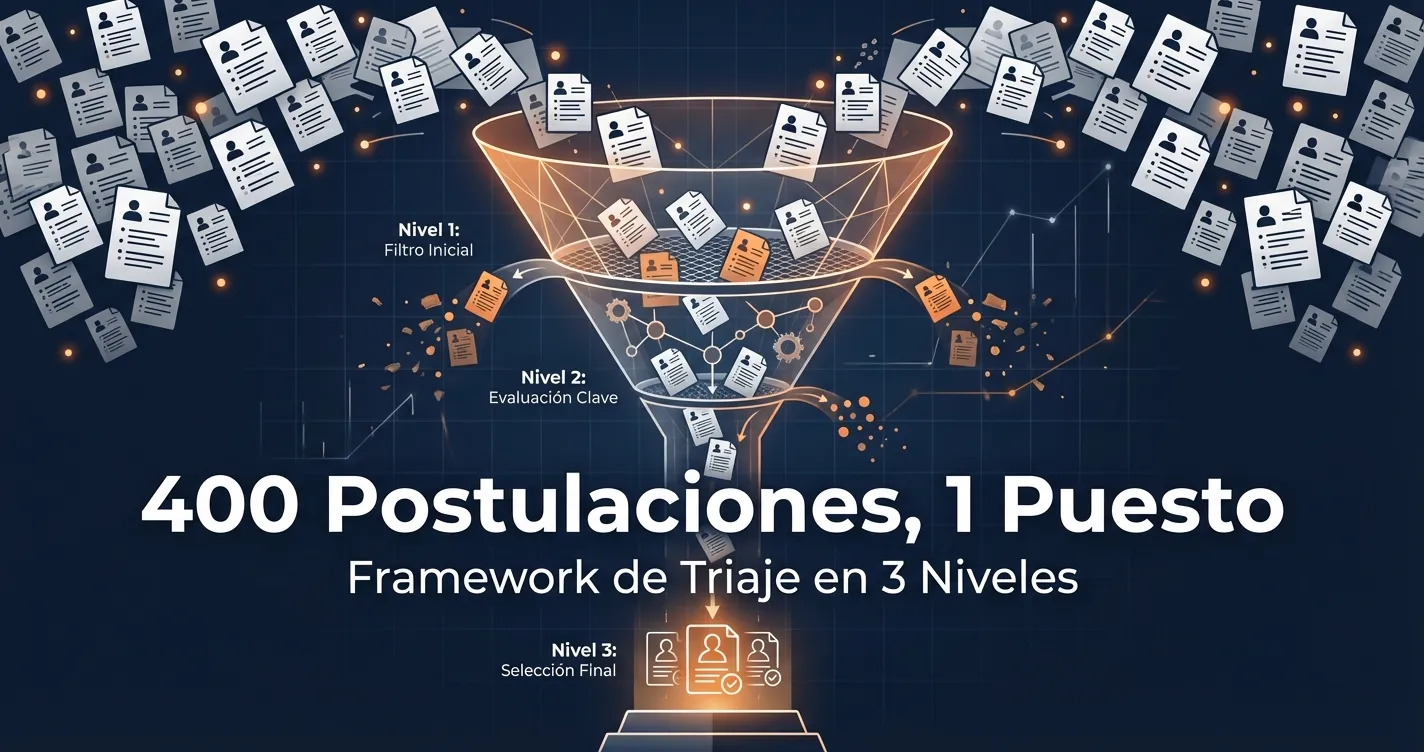
Stage 1 — Mass filter: AI resume screening + initial screening (phone or AI). Goal: from 200 candidates to the top 20. Cost per candidate: minutes.
Stage 2 — Technical and cognitive evaluation: Cognitive tests + technical or software skills assessment depending on the role. Goal: from 20 to the 8-10 technically strongest. Cost per candidate: 45-90 minutes.
Stage 3 — In-depth interview: Competency-based interview + situational + language if applicable. Goal: from 8-10 to 3-4 finalists. Cost per candidate: 60-90 minutes.
Stage 4 — Final validation: Cultural fit + references + interview with the direct manager. Goal: final decision. Cost per candidate: 60-120 minutes.
This model ensures that the highest-cost stages (those requiring the manager's, the team's, or a psychologist's time) are only done with candidates who have already passed the previous filters.
The biggest mistake I see in hiring processes is inverting the order — doing the cultural fit interview before verifying whether the candidate has the skills for the role, or running a long technical round with 50 candidates when it could be 10.
Examples by role type
Backend developer: Resume screening + AI → Cognitive test → Technical interview (live coding or take-home) → Competency-based interview → Cultural fit with the team
B2B salesperson: Resume screening + AI → Screening interview (with knockout questions: experience with long sales cycles, average deal size) → Sales role play → Behavioral interview → Cultural fit with the manager
Customer Success Manager: Resume screening + AI → AI soft skills interview → Situational interview (churn cases, customer escalation) → Competency-based interview → Cultural fit
Data analyst: Resume screening + AI → Cognitive test + numerical aptitude test → Technical test (Python, SQL, Tableau) → Theoretical technical interview → Competencies and cultural fit
How AI is transforming hiring interviews
For decades, interviews had an insurmountable bottleneck: they require human time, and human time doesn't scale. You can screen resumes faster, you can automate logistics, but at some point someone has to talk to the candidate.
AI is breaking that bottleneck.
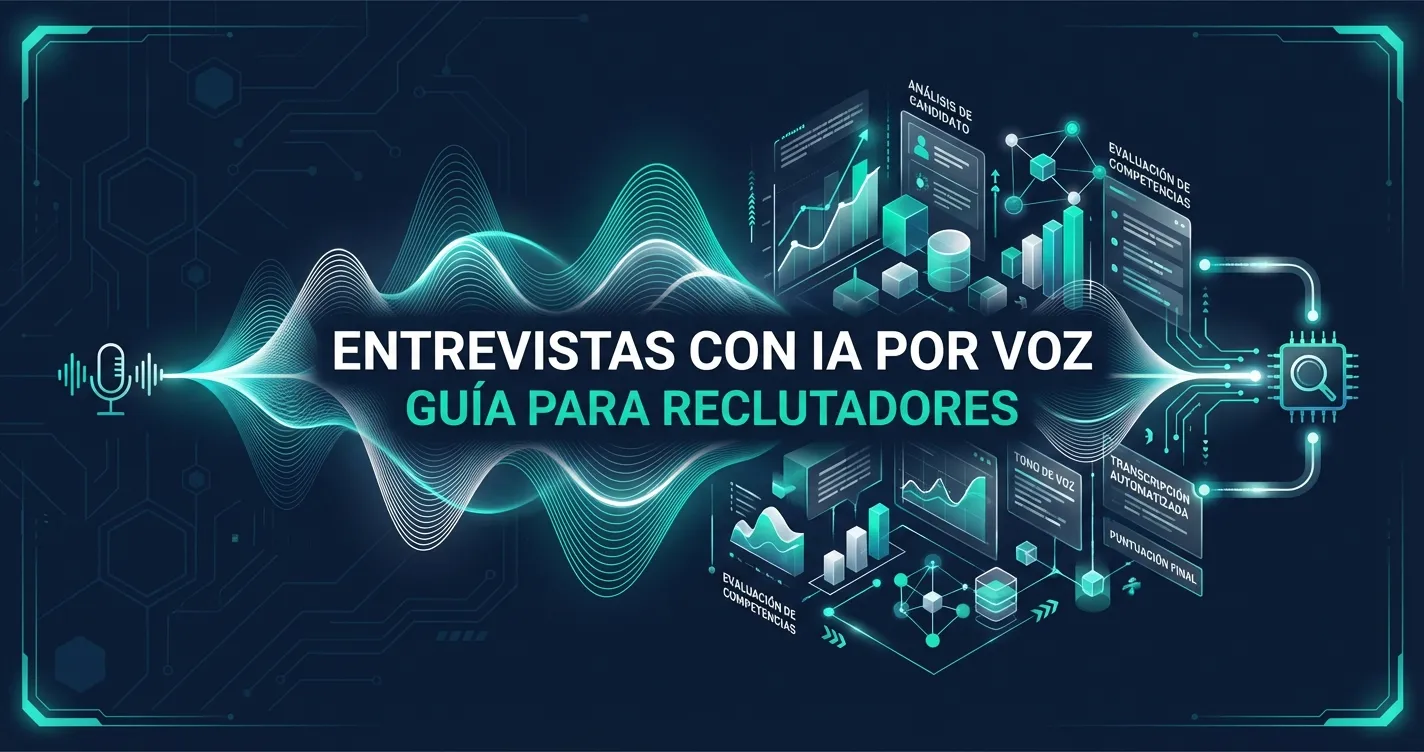
Modern AI interview platforms — like those used by Skillan — conduct voice interviews in real time using advanced language models. The candidate receives a link, enters from their phone or computer, and speaks with an AI that asks role-relevant questions, digs deeper with follow-up questions based on the answers, and evaluates responses across multiple dimensions simultaneously.
The candidate doesn't download anything, doesn't need to create an account, and can do it at 11 PM if that's when they're available. For the candidate who currently has a job and can't step away for an interview during office hours, this changes everything.
For the recruiter, the result isn't a 20-minute audio recording they have to listen to. It's a structured report with:
- Overall score and scores by dimension (communication, technical knowledge, evaluated soft skills)
- Interview transcript
- Detected strengths and areas for improvement
- Recommendation to advance or not
What used to take 20 minutes per candidate now takes 2 minutes of report review.
But there's something more important than the time savings: consistency. When a human conducts 30 screening interviews in a week, they don't evaluate candidate #1 on Monday morning the same way as candidate #28 on Friday afternoon. The AI conducts exactly the same interview, with exactly the same level of attention, all 30 times. That eliminates a significant source of bias.
AI also enables scaling interview types that were previously logistically impossible. A language evaluation for 200 candidates would have required a team of evaluators, weeks of coordination, and a significant budget. With AI, it's 200 language interviews available simultaneously, results in hours.
If you want to understand in depth how AI voice interviews work, the next post in this series covers exactly that: how AI voice interviews work, what they evaluate, and how to interpret the results.
And if the topic of bias in hiring processes interests you, we have a specific guide on how to avoid recruitment bias using AI — one of the most underestimated benefits of these tools.
Frequently asked questions about interview types
How many types of interviews should I include in a hiring process?
It depends on the role and the level. For operational positions with low cost of error, 2-3 types are sufficient (screening + technical or behavioral + cultural fit). For senior leadership roles or critical positions, 4-5 combined types give a much more complete picture of the candidate. The question isn't how many types to use, but which ones are the most predictive for that specific role.
Do AI interviews replace human interviews?
Not entirely, and that's not the goal either. AI interviews are most effective in the screening and initial evaluation stages — where volume is high and consistency matters. Human interviews remain irreplaceable for evaluating deep cultural fit, for senior roles where the interviewer's contextual judgment is key, and for the final hiring decision. The combination of both is what delivers the best results.
Which type of interview best predicts job performance?
The empirical evidence (meta-analysis by Schmidt & Hunter, 1998 and subsequent updates) shows that structured interviews have a predictive validity of 0.51, general ability tests of 0.51, and integrity/conscientiousness tests of 0.41. The combination of structured interview + cognitive test goes up to 0.63. Unstructured interviews have a validity of only 0.38. The biggest mistake is using only unstructured interviews as the sole filter.
Do competency-based interviews work for candidates without work experience?
Classic behavioral interviews rely on previous experiences, which makes them less useful for first-job candidates or major industry changes. For these cases, situational interviews (what would you do in this situation) and cognitive and aptitude assessments are more useful. You can also use academic experiences, personal projects, or volunteer work as sources of behavioral examples.
How do I evaluate a candidate who gets very nervous in interviews?
Interview nervousness doesn't necessarily correlate with job performance — unless the role involves high exposure to interpersonal pressure situations. If a technically solid candidate stumbles in a live interview, consider alternatives: an asynchronous interview where they can record their answers, a take-home challenge where they demonstrate their skills without time pressure, or a more informal interview (like a company tour) where the context is less intimidating. The goal is to measure what matters for the role, not the ability to manage the stress of the interview itself.
What is the difference between a competency-based interview and a situational interview?
The main difference is temporal. The competency-based interview looks at the past: "tell me about a time when..." and seeks real previous behaviors. The situational interview looks at the future: "if X happened to you, what would you do?" and seeks reasoning and values. They're complementary: the behavioral one reveals what the candidate did, the situational one reveals how they think. For candidates with experience, the behavioral interview is more predictive. For candidates without prior experience in the role, the situational interview provides more information.
Mastering the available types of interviews isn't an academic exercise — it's the difference between hiring candidates who fit well from the first month and candidates who leave after three. Each type of interview exists because it measures something the others can't. The key is choosing the right ones for each role and combining them in a way that covers the dimensions that matter most.
If you haven't yet integrated AI resume screening into your process, that's the first step. Not because it's the technology of the moment, but because it frees up the time you can then invest in conducting better interviews with the candidates who truly matter. You can see how it works in the guide on AI candidate screening or explore it directly at Skillan Academy.
Skillan is a resume screening and AI interview platform for recruiters in LATAM. It features 80+ interview types across 11 categories, available 24/7 via natural voice.
Keep reading
- AI candidate screening: step-by-step guide — How to automate resume reading and arrive at interviews with the best pre-filtered candidates.
- AI voice interviews: how they work — What happens inside an AI interview, what it evaluates, and how to interpret the results.
- How to evaluate soft skills with AI — Communication, leadership, critical thinking: the competencies a resume can't measure.
- Recruitment bias: how to avoid it with AI — Why manual processes generate bias and what AI does to reduce it.